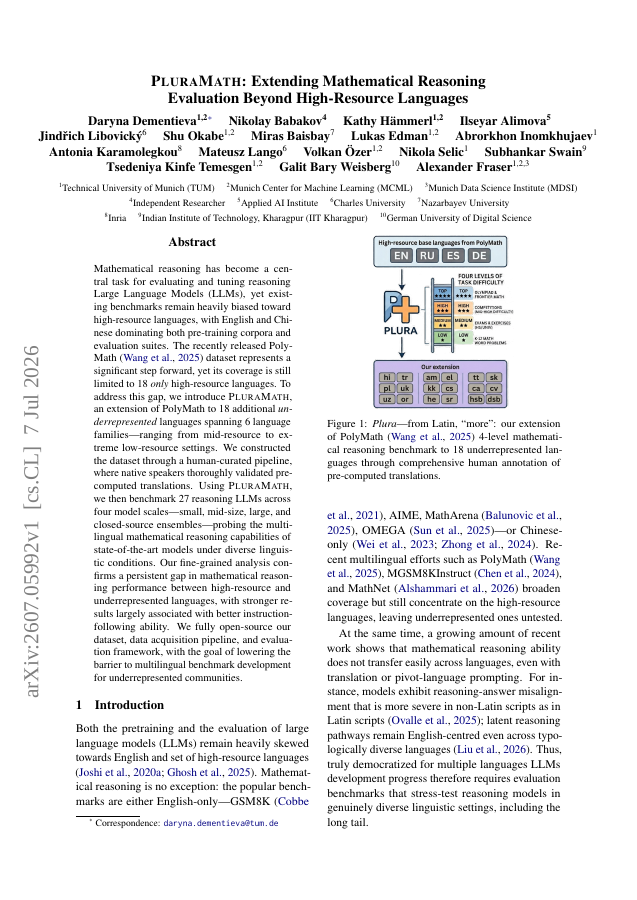
Mathematical reasoning has become a central task for evaluating and tuning reasoning Large Language Models (LLMs), yet existing benchmarks remain heavily biased toward high-resource languages, with English and Chinese dominating both pre-training corpora and evaluation suites. The recently released PolyMath (Wang et al., 2025) dataset represents a significant step forward, yet its coverage is still limited to 18 only high-resource languages. To address this gap, we introduce PluraMath, an extension of PolyMath to 18 additional {underrepresented languages spanning 6 language families -- ranging from mid-resource to extreme low-resource settings. We constructed the dataset through a human-curated pipeline, where native speakers thoroughly validated pre-computed translations. Using PluraMath, we then benchmark 27 reasoning LLMs across four model scales -- small, mid-size, large, and closed-source ensembles -- probing the multilingual mathematical reasoning capabilities of state-of-the-art models under diverse linguistic conditions. Our fine-grained analysis confirms a persistent gap in mathematical reasoning performance between high-resource and underrepresented languages, with stronger results largely associated with better instruction-following ability. We fully open-source our dataset, data acquisition pipeline, and evaluation framework, with the goal of lowering the barrier to multilingual benchmark development for underrepresented communities.
PluraMath: Extending Mathematical Reasoning Evaluation Beyond High-Resource Languages
Mathematical reasoning has become a central task for evaluating and tuning reasoning Large Language Models (LLMs), yet existing benchmarks remain heavily biased toward high-resource languages, with English and Chinese dominating both pre-training corpora and evaluation suites.
- Preview
- Year
- 2026
- Hosting
- Full text hostedCC-BY-SA-4.0
Cite
Notes
Only stored in your browser.
Attribution
- Abstract & full text
- arxiv.org/abs/2607.05992CC-BY-SA-4.0
- TL;DR
- Semantic Scholar