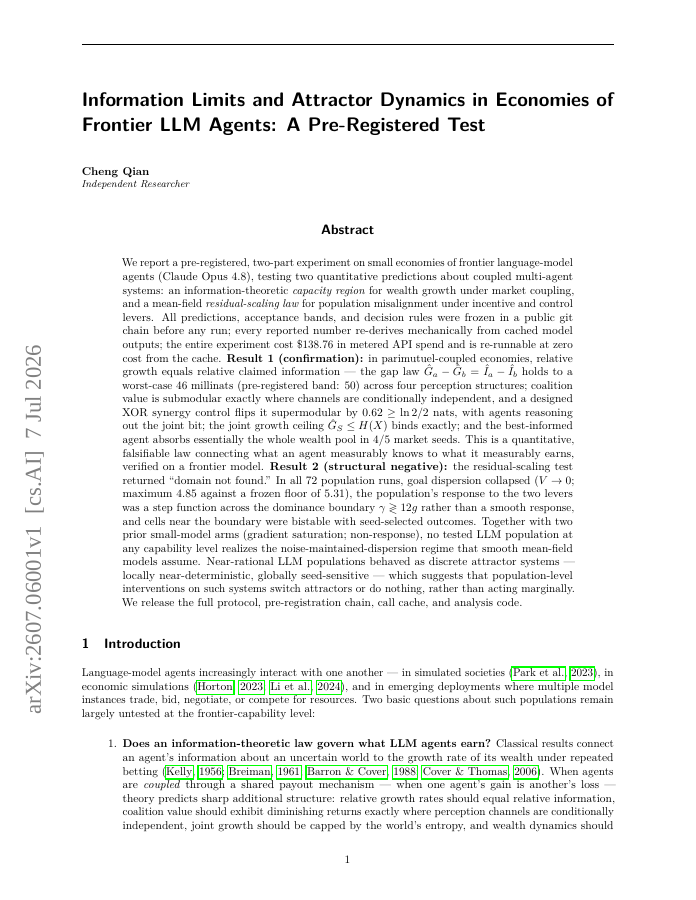
We report a pre-registered, two-part experiment on small economies of frontier language-model agents (Claude Opus 4.8), testing two quantitative predictions about coupled multi-agent systems: an information-theoretic capacity region for wealth growth under market coupling, and a mean-field residual-scaling law for population misalignment under incentive and control levers. All predictions, acceptance bands, and decision rules were frozen in a public git chain before any run; every reported number re-derives mechanically from cached model outputs; the entire experiment cost $138.76 in metered API spend and is re-runnable at zero cost from the cache. Result 1 (confirmation): in parimutuel-coupled economies, relative growth equals relative claimed information -- the gap law G_a - G_b = I_a - I_b holds to a worst-case 46 millinats (pre-registered band: 50) across four perception structures; coalition value is submodular exactly where channels are conditionally independent, and a designed XOR synergy control flips it supermodular by 0.62 >= ln2/2 nats, with agents reasoning out the joint bit; the joint growth ceiling G_S <= H(X) binds exactly; and the best-informed agent absorbs essentially the whole wealth pool in 4/5 market seeds. Result 2 (structural negative): the residual-scaling test returned "domain not found." In all 72 population runs, goal dispersion collapsed (V -> 0; maximum 4.85 against a frozen floor of 5.31), the population's response to the two levers was a step function across the dominance boundary rather than a smooth response, and cells near the boundary were bistable with seed-selected outcomes. No tested LLM population at any capability level realizes the noise-maintained-dispersion regime the smooth mean-field model assumes. We release the full protocol, pre-registration chain, call cache, and analysis code.
Information Limits and Attractor Dynamics in Economies of Frontier LLM Agents: A Pre-Registered Test
We report a pre-registered, two-part experiment on small economies of frontier language-model agents (Claude Opus 4.8), testing two quantitative predictions about coupled multi-agent systems: an information-theoretic capacity region for wealth growth under market coupling, and a…
- Preview
- Year
- 2026
- Hosting
- Full text hostedCC-BY-4.0
Cite
Notes
Only stored in your browser.
Attribution
- Abstract & full text
- arxiv.org/abs/2607.06001CC-BY-4.0
- TL;DR
- Semantic Scholar