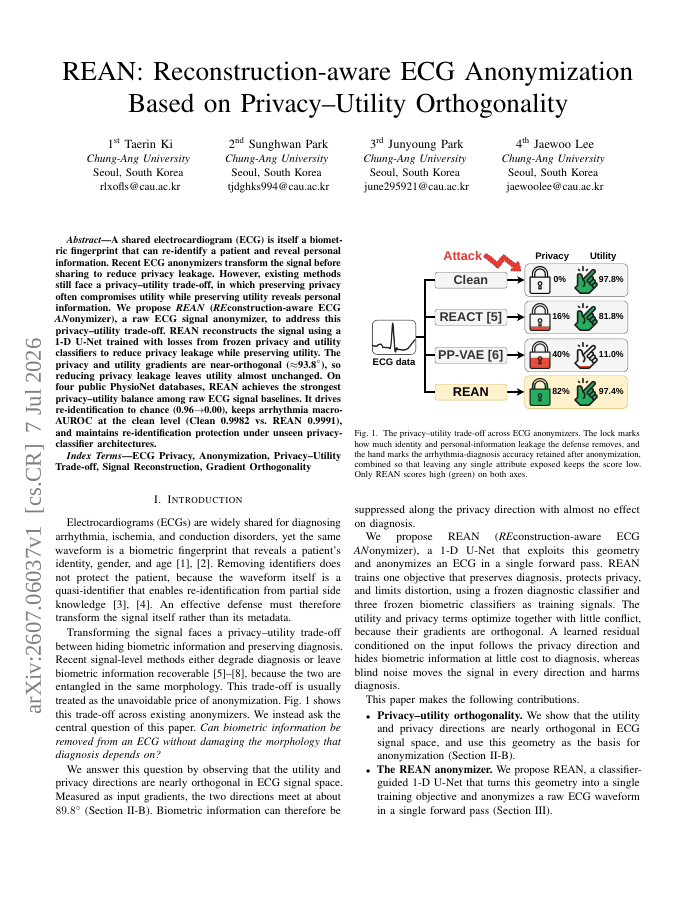
A shared electrocardiogram (ECG) is itself a biometric fingerprint that can re-identify a patient and reveal personal information. Recent ECG anonymizers transform the signal before sharing to reduce privacy leakage. However, existing methods still face a privacy--utility trade-off, in which preserving privacy often compromises utility while preserving utility reveals personal information. We propose REAN (REconstruction-aware ECG ANonymizer), a raw ECG signal anonymizer, to address this privacy--utility trade-off. REAN reconstructs the signal using a 1-D U-Net trained with losses from frozen privacy and utility classifiers to reduce privacy leakage while preserving utility. The privacy and utility gradients are near-orthogonal (\approx93.8^\circ), so reducing privacy leakage leaves utility almost unchanged. On four public PhysioNet databases, REAN achieves the strongest privacy--utility balance among raw ECG signal baselines. It drives re-identification to chance (0.96\to0.00), keeps arrhythmia macro-AUROC at the clean level (Clean 0.9982 vs.\ REAN 0.9991), and maintains re-identification protection under unseen privacy-classifier architectures.
REAN: Reconstruction-aware ECG Anonymization Based on Privacy--Utility Orthogonality
A shared electrocardiogram (ECG) is itself a biometric fingerprint that can re-identify a patient and reveal personal information. Recent ECG anonymizers transform the signal before sharing to reduce privacy leakage.
- Preview
- Year
- 2026
- Hosting
- Full text hostedCC-BY-4.0
Cite
Notes
Only stored in your browser.
Attribution
- Abstract & full text
- arxiv.org/abs/2607.06037CC-BY-4.0
- TL;DR
- Semantic Scholar