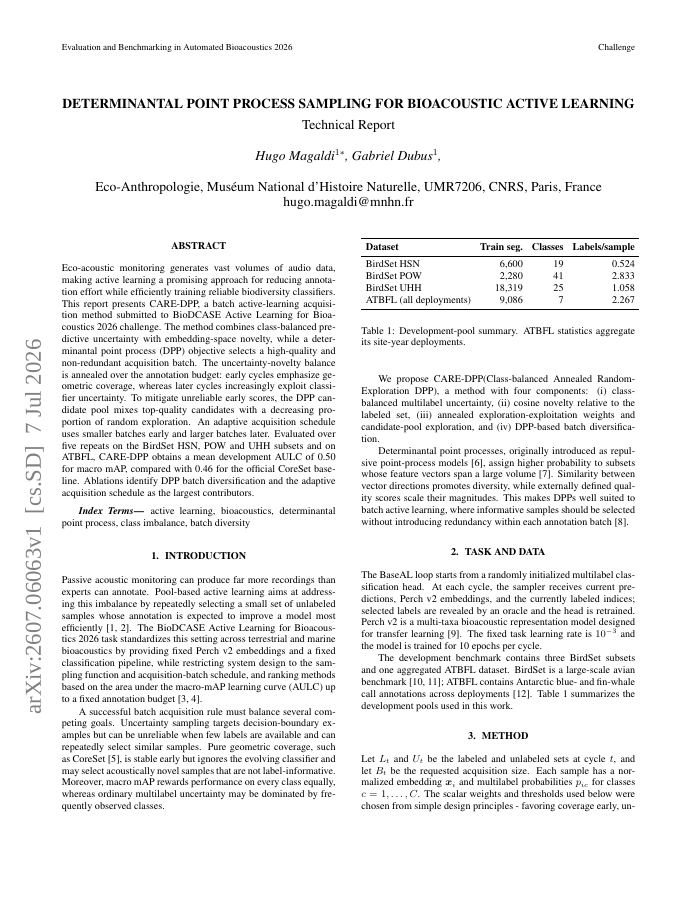
Eco-acoustic monitoring generates vast volumes of audio data, making active learning a promising approach for reducing annotation effort while efficiently training reliable biodiversity classifiers. This report presents CARE-DPP, a batch active-learning acquisition method submitted to BioDCASE Active Learning for Bioacoustics 2026 challenge. The method combines class-balanced predictive uncertainty with embedding-space novelty, while a determinantal point process (DPP) objective selects a high-quality and non-redundant acquisition batch. The uncertainty-novelty balance is annealed over the annotation budget: early cycles emphasize geometric coverage, whereas later cycles increasingly exploit classifier uncertainty. To mitigate unreliable early scores, the DPP candidate pool mixes top-quality candidates with a decreasing proportion of random exploration. An adaptive acquisition schedule uses smaller batches early and larger batches later. Evaluated over five repeats on the BirdSet HSN, POW and UHH subsets and on ATBFL, CARE-DPP obtains a mean development AULC of 0.50 for macro mAP, compared with 0.46 for the official CoreSet baseline. Ablations identify DPP batch diversification and the adaptive acquisition schedule as the largest contributors.
Determinantal point process sampling for bioacoustic active learning
Eco-acoustic monitoring generates vast volumes of audio data, making active learning a promising approach for reducing annotation effort while efficiently training reliable biodiversity classifiers.
- Preview
- Year
- 2026
- Hosting
- Full text hostedCC-BY-4.0
Cite
Notes
Only stored in your browser.
Attribution
- Abstract & full text
- arxiv.org/abs/2607.06063CC-BY-4.0
- TL;DR
- Semantic Scholar