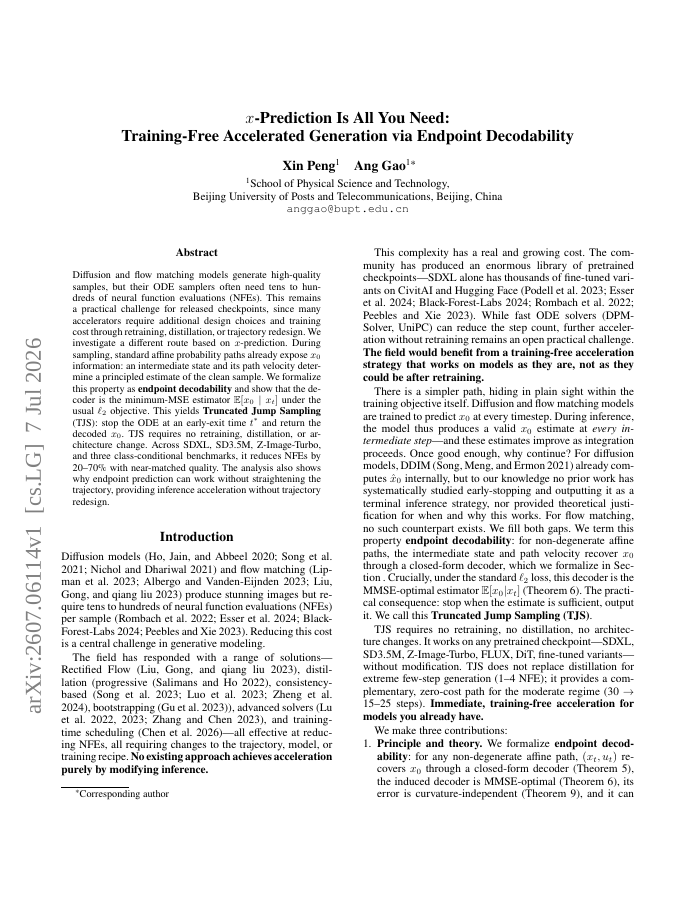
Diffusion and flow matching models generate high-quality samples, but their ODE samplers often need tens to hundreds of neural function evaluations (NFEs). This remains a practical challenge for released checkpoints, since many accelerators require additional design choices and training cost through retraining, distillation, or trajectory redesign. We investigate a different route based on x-prediction. During sampling, standard affine probability paths already expose x_0 information: an intermediate state and its path velocity determine a principled estimate of the clean sample. We formalize this property as endpoint decodability and show that the decoder is the minimum-MSE estimator \mathbb{E}[x_0\mid x_t] under the usual \ell_2 objective. This yields Truncated Jump Sampling (TJS): stop the ODE at an early-exit time t^* and return the decoded x_0. TJS requires no retraining, distillation, or architecture change. Across SDXL, SD3.5M, Z-Image-Turbo, and three class-conditional benchmarks, it reduces NFEs by 20--70% with near-matched quality. The analysis also shows why endpoint prediction can work without straightening the trajectory, providing inference acceleration without trajectory redesign.
x-Prediction Is All You Need:Training-Free Accelerated Generation via Endpoint Decodability
Diffusion and flow matching models generate high-quality samples, but their ODE samplers often need tens to hundreds of neural function evaluations (NFEs). This remains a practical challenge for released checkpoints, since many accelerators require additional design choices and…
- Preview
- Year
- 2026
- Hosting
- Full text hostedCC-BY-4.0
Cite
Notes
Only stored in your browser.
Attribution
- Abstract & full text
- arxiv.org/abs/2607.06114CC-BY-4.0
- TL;DR
- Semantic Scholar