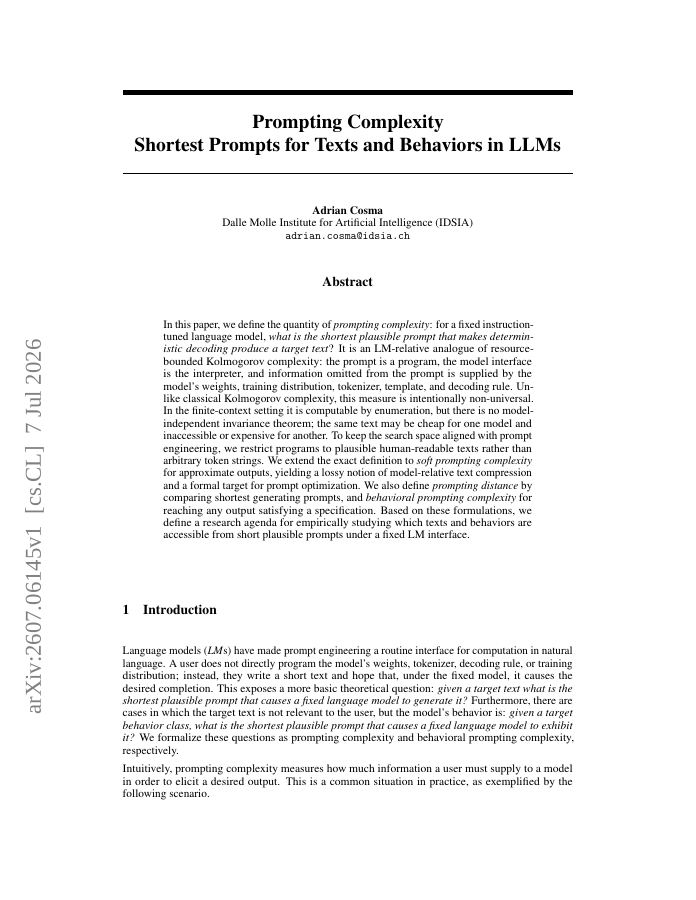
In this paper, we define the quantity of prompting complexity: for a fixed instruction-tuned language model, what is the shortest plausible prompt that makes deterministic decoding produce a target text? It is an LM-relative analogue of resource-bounded Kolmogorov complexity: the prompt is a program, the model interface is the interpreter, and information omitted from the prompt is supplied by the model's weights, training distribution, tokenizer, template, and decoding rule. Unlike classical Kolmogorov complexity, this measure is intentionally non-universal. In the finite-context setting it is computable by enumeration, but there is no model-independent invariance theorem; the same text may be cheap for one model and inaccessible or expensive for another. To keep the search space aligned with prompt engineering, we restrict programs to plausible human-readable texts rather than arbitrary token strings. We extend the exact definition to soft prompting complexity for approximate outputs, yielding a lossy notion of model-relative text compression and a formal target for prompt optimization. We also define prompting distance by comparing shortest generating prompts, and behavioral prompting complexity for reaching any output satisfying a specification. Based on these formulations, we define a research agenda for empirically studying which texts and behaviors are accessible from short plausible prompts under a fixed LM interface.
Prompting Complexity: Shortest Prompts for Texts and Behaviors in LLMs
In this paper, we define the quantity of prompting complexity: for a fixed instruction-tuned language model, what is the shortest plausible prompt that makes deterministic decoding produce a target text? It is an LM-relative analogue of resource-bounded Kolmogorov complexity:…
- Preview
- Year
- 2026
- Hosting
- Excerpt onlyCC-BY-NC-4.0
Cite
Notes
Only stored in your browser.
Attribution
- Abstract & full text
- arxiv.org/abs/2607.06145CC-BY-NC-4.0
- TL;DR
- Semantic Scholar