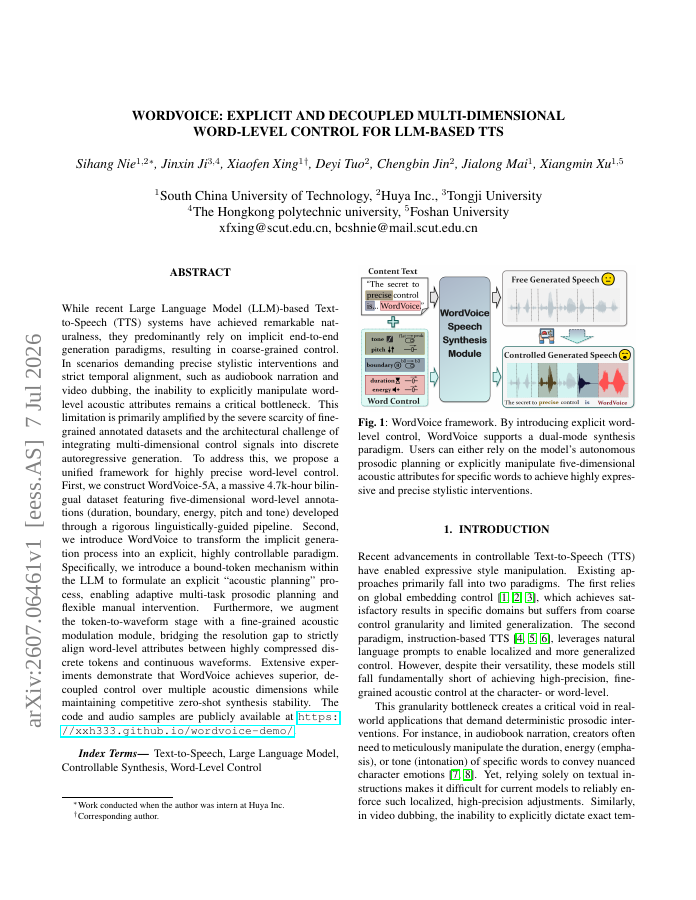
While recent Large Language Model (LLM)-based Text-to-Speech (TTS) systems have achieved remarkable naturalness, they predominantly rely on implicit end-to-end generation paradigms, resulting in coarse-grained control. In scenarios demanding precise stylistic interventions and strict temporal alignment, such as audiobook narration and video dubbing, the inability to explicitly manipulate word-level acoustic attributes remains a critical bottleneck. This limitation is primarily amplified by the severe scarcity of fine-grained annotated datasets and the architectural challenge of integrating multi-dimensional control signals into discrete autoregressive generation. To address this, we propose a unified framework for highly precise word-level control. First, we construct WordVoice-5A, a massive 4.7k-hour bilingual dataset featuring five-dimensional word-level annotations (duration, boundary, energy, pitch and tone) developed through a rigorous linguistically-guided pipeline. Second, we introduce WordVoice to transform the implicit generation process into an explicit, highly controllable paradigm. Specifically, we introduce a bound-token mechanism within the LLM to formulate an explicit ``acoustic planning'' process, enabling adaptive multi-task prosodic planning and flexible manual intervention. Furthermore, we augment the token-to-waveform stage with a fine-grained acoustic modulation module, bridging the resolution gap to strictly align word-level attributes between highly compressed discrete tokens and continuous waveforms. Extensive experiments demonstrate that WordVoice achieves superior, decoupled control over multiple acoustic dimensions while maintaining competitive zero-shot synthesis stability. The code and audio samples are publicly available at https://xxh333.github.io/wordvoice-demo/.
WordVoice: Explicit and Decoupled Multi-Dimensional Word-Level Control for LLM-Based TTS
While recent Large Language Model (LLM)-based Text-to-Speech (TTS) systems have achieved remarkable naturalness, they predominantly rely on implicit end-to-end generation paradigms, resulting in coarse-grained control.
- Preview
- Year
- 2026
- Hosting
- Full text hostedCC-BY-4.0
Cite
Notes
Only stored in your browser.
Attribution
- Abstract & full text
- arxiv.org/abs/2607.06461CC-BY-4.0
- TL;DR
- Semantic Scholar