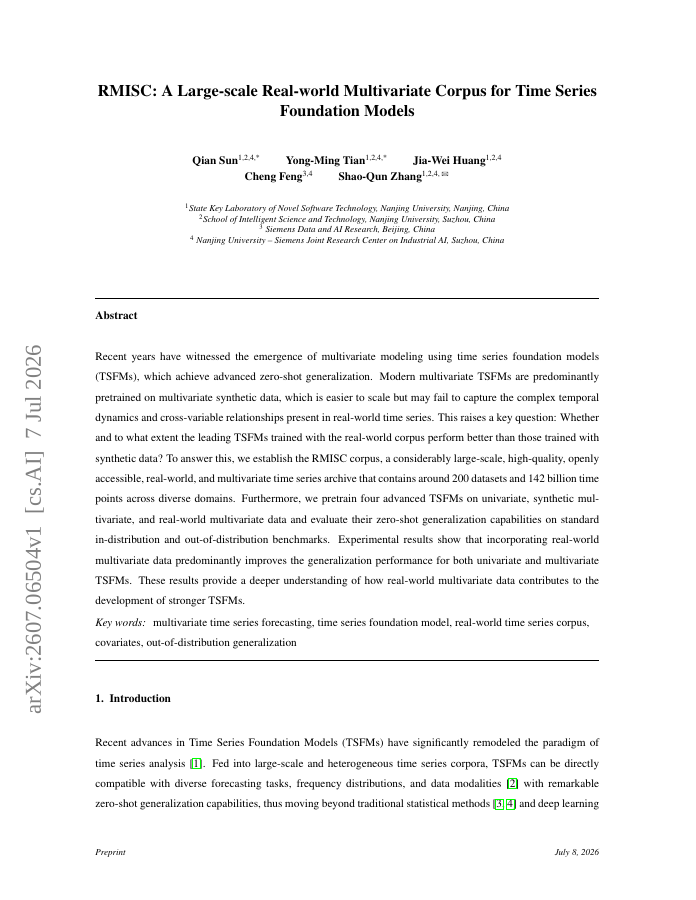
Recent years have witnessed the emergence of multivariate modeling using time series foundation models (TSFMs), which achieve advanced zero-shot generalization. Modern multivariate TSFMs are predominantly pretrained on multivariate synthetic data, which is easier to scale but may fail to capture the complex temporal dynamics and cross-variable relationships present in real-world time series. This raises a key question: Whether and to what extent the leading TSFMs trained with the real-world corpus perform better than those trained with synthetic data? To answer this, we establish the RMISC corpus, a considerably large-scale, high-quality, openly accessible, real-world, and multivariate time series archive that contains around 200 datasets and 142 billion time points across diverse domains. Furthermore, we pretrain four advanced TSFMs on univariate, synthetic multivariate, and real-world multivariate data and evaluate their zero-shot generalization capabilities on standard in-distribution and out-of-distribution benchmarks. Experimental results show that incorporating real-world multivariate data predominantly improves the generalization performance for both univariate and multivariate TSFMs. These results provide a deeper understanding of how real-world multivariate data contributes to the development of stronger TSFMs.
RMISC: A Large-scale Real-world Multivariate Corpus for Time Series Foundation Models
Recent years have witnessed the emergence of multivariate modeling using time series foundation models (TSFMs), which achieve advanced zero-shot generalization. Modern multivariate TSFMs are predominantly pretrained on multivariate synthetic data, which is easier to scale but…
- Preview
- Year
- 2026
- Hosting
- Abstract onlyARXIV-DEFAULT
Cite
Notes
Only stored in your browser.
Attribution
- Abstract & full text
- arxiv.org/abs/2607.06504ARXIV-DEFAULT
- TL;DR
- Semantic Scholar