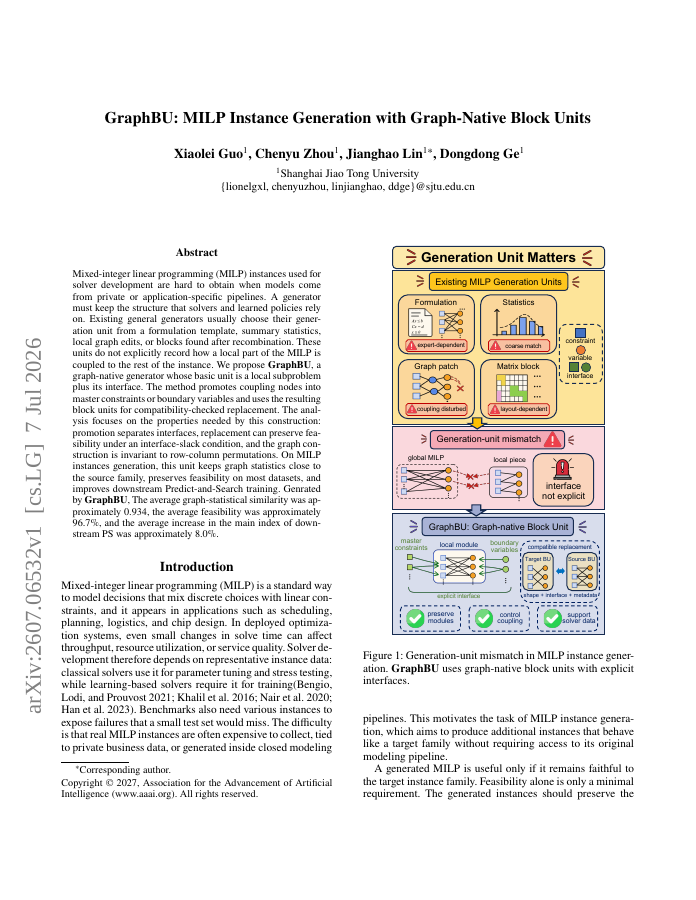
Mixed-integer linear programming (MILP) instances used for solver development are hard to obtain when models come from private or application-specific pipelines. A generator must keep the structure that solvers and learned policies rely on. Existing general generators usually choose their generation unit from a formulation template, summary statistics, local graph edits, or blocks found after recombination. These units do not explicitly record how a local part of the MILP is coupled to the rest of the instance. We propose GraphBU, a graph-native generator whose basic unit is a local subproblem plus its interface. The method promotes coupling nodes into master constraints or boundary variables and uses the resulting block units for compatibility-checked replacement. The analysis focuses on the properties needed by this construction: promotion separates interfaces, replacement can preserve feasibility under an interface-slack condition, and the graph construction is invariant to row-column permutations. On MILP instances generation, this unit keeps graph statistics close to the source family, preserves feasibility on most datasets, and improves downstream Predict-and-Search training. Genrated by GraphBU, The average graph-statistical similarity was approximately 0.934, the average feasibility was approximately 96.7%, and the average increase in the main index of downstream PS was approximately 8.0%.
GraphBU: MILP Instance Generation with Graph-Native Block Units
Mixed-integer linear programming (MILP) instances used for solver development are hard to obtain when models come from private or application-specific pipelines. A generator must keep the structure that solvers and learned policies rely on.
- Preview
- Year
- 2026
- Hosting
- Full text hostedCC-BY-4.0
Cite
Notes
Only stored in your browser.
Attribution
- Abstract & full text
- arxiv.org/abs/2607.06532CC-BY-4.0
- TL;DR
- Semantic Scholar