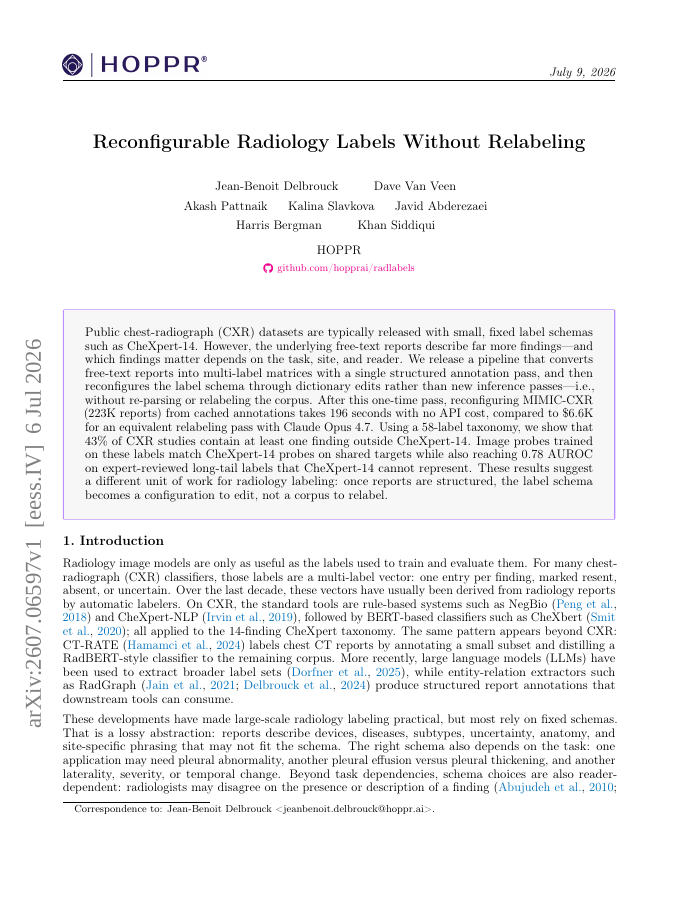
Public chest-radiograph (CXR) datasets are typically released with small, fixed label schemas such as CheXpert-14. However, the underlying free-text reports describe far more findings -- and which findings matter depends on the task, site, and reader. We release a pipeline that converts free-text reports into multi-label matrices and then reconfigures the label schema through dictionary edits rather than new inference passes, i.e., without relabeling the corpus. After this one-time pass, reconfiguring MIMIC-CXR (223K reports) from cached annotations takes 196 seconds with no API cost, compared to $6.6K for an equivalent relabeling pass with Claude Opus 4.7. Using a 58-label taxonomy, we show that 43% of CXR studies contain at least one finding outside CheXpert-14. Image probes trained on these labels match CheXpert-14 probes on shared targets while also reaching 0.78 AUROC on expert-reviewed long-tail labels that CheXpert-14 cannot represent. These results suggest a different unit of work for radiology labeling: once reports are structured, the label schema becomes a configuration to edit, not a corpus to relabel.
Reconfigurable Radiology Labels Without Relabeling
Public chest-radiograph (CXR) datasets are typically released with small, fixed label schemas such as CheXpert-14. However, the underlying free-text reports describe far more findings -- and which findings matter depends on the task, site, and reader.
- Preview
- Year
- 2026
- Hosting
- Excerpt onlyCC-BY-NC-4.0
Cite
Notes
Only stored in your browser.
Attribution
- Abstract & full text
- arxiv.org/abs/2607.06597CC-BY-NC-4.0
- TL;DR
- Semantic Scholar