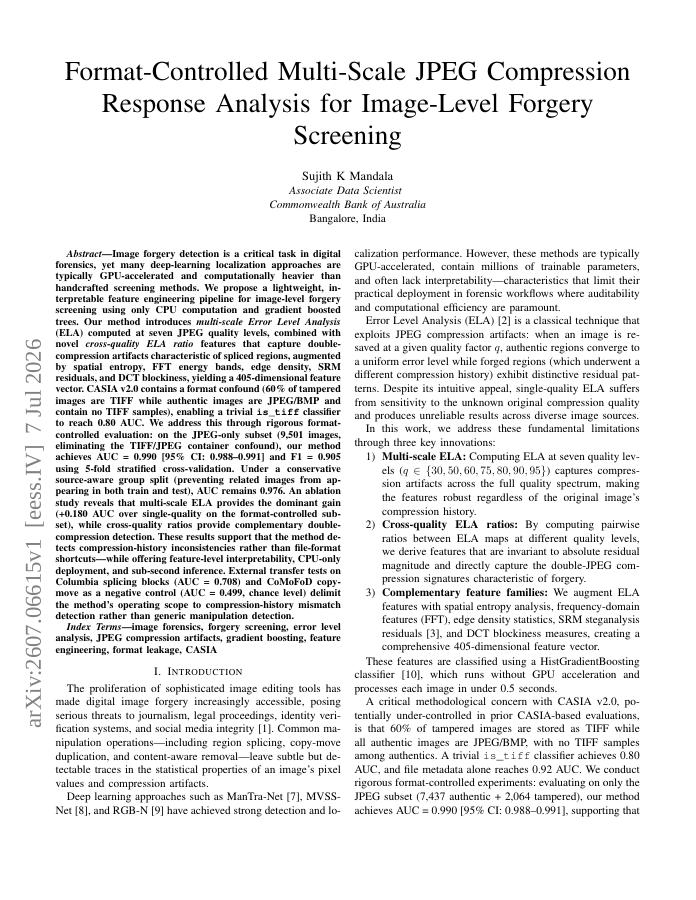
Image forgery detection is a critical task in digital forensics, yet many deep-learning localization approaches are typically GPU-accelerated and computationally heavier than handcrafted screening methods. We propose a lightweight, interpretable feature engineering pipeline for image-level forgery screening using only CPU computation and gradient boosted trees. Our method introduces multi-scale Error Level Analysis (ELA) computed at seven JPEG quality levels, combined with novel cross-quality ELA ratio features that capture double-compression artifacts characteristic of spliced regions, augmented by spatial entropy, FFT energy bands, edge density, SRM residuals, and DCT blockiness, yielding a 405-dimensional feature vector. CASIA v2.0 contains a format confound (60% of tampered images are TIFF while authentic images are JPEG/BMP and contain no TIFF samples), enabling a trivial is_tiff classifier to reach 0.80 AUC. We address this through rigorous format-controlled evaluation: on the JPEG-only subset (9,501 images, eliminating the TIFF/JPEG container confound), our method achieves AUC = 0.990 [95% CI: 0.988--0.991] and F1 = 0.905 using 5-fold stratified cross-validation. Under a conservative source-aware group split (preventing related images from appearing in both train and test), AUC remains 0.976. An ablation study reveals that multi-scale ELA provides the dominant gain (+0.180 AUC over single-quality on the format-controlled subset), while cross-quality ratios provide complementary double-compression detection. These results support that the method detects compression-history inconsistencies rather than file-format shortcuts -- while offering feature-level interpretability, CPU-only deployment, and sub-second inference.
Format-Controlled Multi-Scale JPEG Compression Response Analysis for Image-Level Forgery Screening
Image forgery detection is a critical task in digital forensics, yet many deep-learning localization approaches are typically GPU-accelerated and computationally heavier than handcrafted screening methods.
- Preview
- Year
- 2026
- Hosting
- Full text hostedCC-BY-4.0
Cite
Notes
Only stored in your browser.
Attribution
- Abstract & full text
- arxiv.org/abs/2607.06615CC-BY-4.0
- TL;DR
- Semantic Scholar