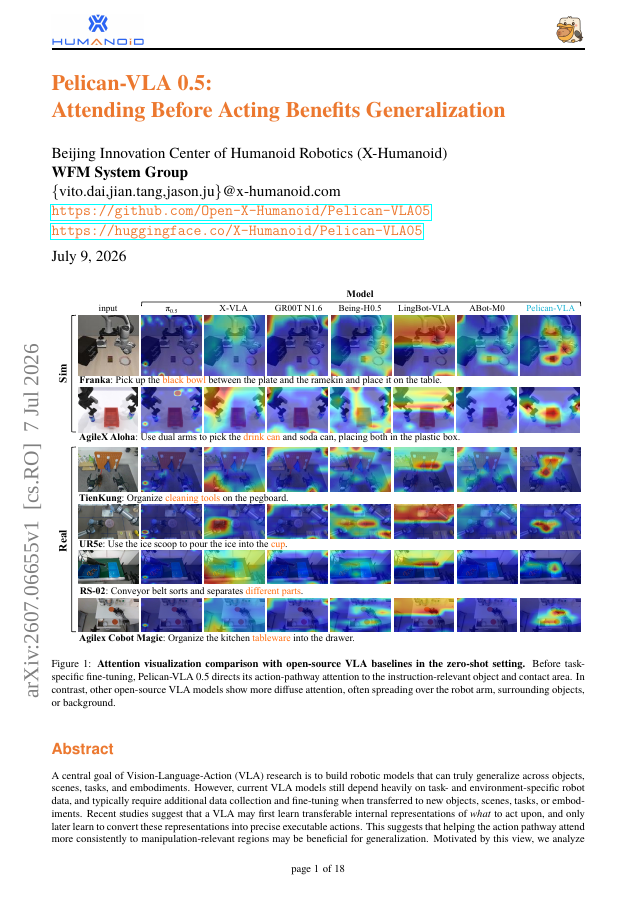
In this report, we present Pelican-VLA 0.5, a unified VLA model that integrates vision-language understanding, future-frame generation, and action prediction within a single architecture. Pelican-VLA 0.5 achieves attention-level generalization: without object annotations, segmentation masks, attention supervision, or task-specific fine-tuning, its action pathway already focuses on the instruction-relevant object and contact region. This behavior persists across unseen scenes and unseen robot embodiments, and is substantially stronger than in other open-source VLA baselines. We verify that this ability originates from the learnable Reasoning Slots inserted between perception and action: by routing task-relevant visual information through a compact bottleneck, the slot interface induces manipulation-centric attention during pre-training and remains effective across different policy structures, including a MoT-style architecture.
Pelican-VLA 0.5: Attending Before Acting Benefits Generalization
In this report, we present Pelican-VLA 0.5, a unified VLA model that integrates vision-language understanding, future-frame generation, and action prediction within a single architecture.
- Preview
- Year
- 2026
- Hosting
- Abstract onlyARXIV-DEFAULT
Cite
Notes
Only stored in your browser.
Attribution
- Abstract & full text
- arxiv.org/abs/2607.06655ARXIV-DEFAULT
- TL;DR
- Semantic Scholar