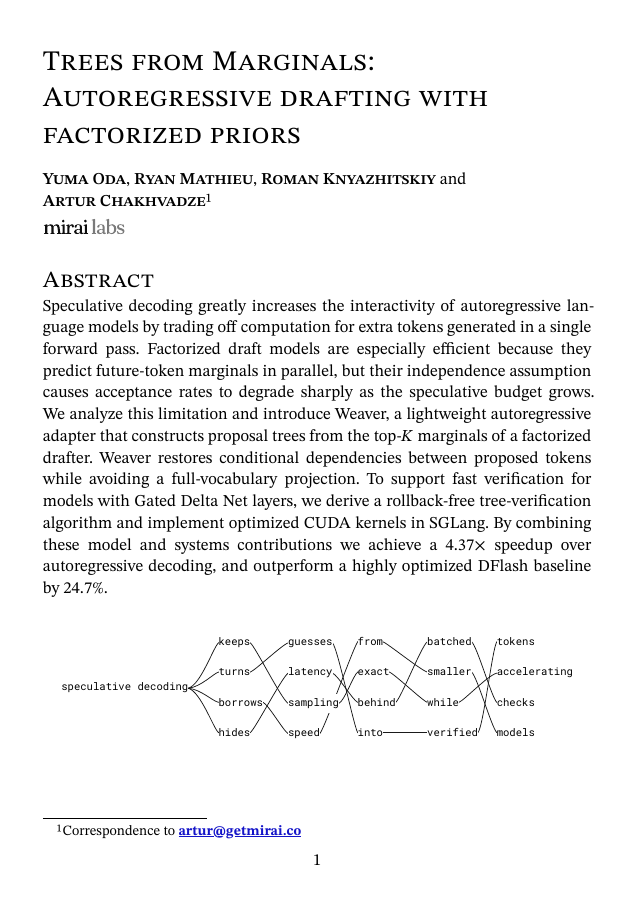
Speculative decoding greatly increases the interactivity of autoregressive language models by trading off computation for extra tokens generated in a single forward pass. Factorized draft models are especially efficient because they predict future-token marginals in parallel, but their independence assumption causes acceptance rates to degrade sharply as the speculative budget grows. We analyze this limitation and introduce Weaver, a lightweight autoregressive adapter that constructs proposal trees from the top-K marginals of a factorized drafter. Weaver restores conditional dependencies between proposed tokens while avoiding a full-vocabulary projection. To support fast verification for models with Gated Delta Net layers, we derive a rollback-free tree-verification algorithm and implement optimized CUDA kernels in SGLang. By combining these model and systems contributions we achieve a 4.37-fold speedup over autoregressive decoding, and outperform a highly optimized DFlash baseline by 24.7%.
Trees from Marginals: Autoregressive drafting with factorized priors
Speculative decoding greatly increases the interactivity of autoregressive language models by trading off computation for extra tokens generated in a single forward pass.
- Preview
- Year
- 2026
- Hosting
- Full text hostedCC-BY-4.0
Cite
Notes
Only stored in your browser.
Attribution
- Abstract & full text
- arxiv.org/abs/2607.06763CC-BY-4.0
- TL;DR
- Semantic Scholar