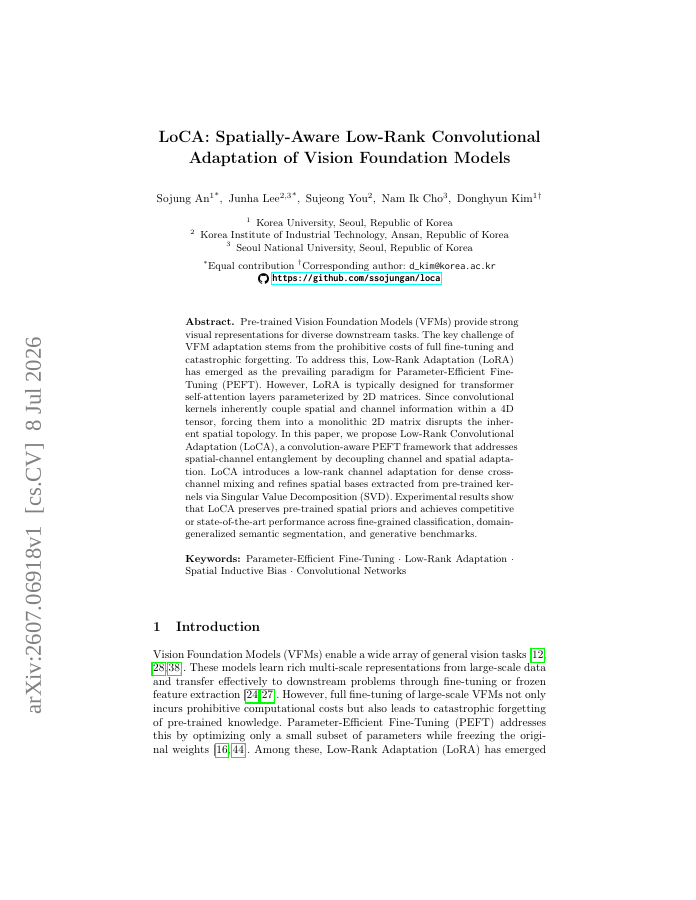
Pre-trained Vision Foundation Models (VFMs) provide strong visual representations for diverse downstream tasks. The key challenge of VFM adaptation stems from the prohibitive costs of full fine-tuning and catastrophic forgetting. To address this, Low-Rank Adaptation (LoRA) has emerged as the prevailing paradigm for Parameter-Efficient Fine-Tuning (PEFT). However, LoRA is typically designed for transformer self-attention layers parameterized by 2D matrices. Since convolutional kernels inherently couple spatial and channel information within a 4D tensor, forcing them into a monolithic 2D matrix disrupts the inherent spatial topology. In this paper, we propose Low-Rank Convolutional Adaptation (LoCA), a convolution-aware PEFT framework that addresses spatial-channel entanglement by decoupling channel and spatial adaptation. LoCA introduces a low-rank channel adaptation for dense cross-channel mixing and refines spatial bases extracted from pre-trained kernels via Singular Value Decomposition (SVD). Experimental results show that LoCA preserves pre-trained spatial priors and achieves competitive or state-of-the-art performance across fine-grained classification, domain-generalized semantic segmentation, and generative benchmarks.
LoCA: Spatially-Aware Low-Rank Convolutional Adaptation of Vision Foundation Models
Pre-trained Vision Foundation Models (VFMs) provide strong visual representations for diverse downstream tasks. The key challenge of VFM adaptation stems from the prohibitive costs of full fine-tuning and catastrophic forgetting.
- Preview
- Year
- 2026
- Hosting
- Abstract onlyARXIV-DEFAULT
Cite
Notes
Only stored in your browser.
Attribution
- Abstract & full text
- arxiv.org/abs/2607.06918ARXIV-DEFAULT
- TL;DR
- Semantic Scholar