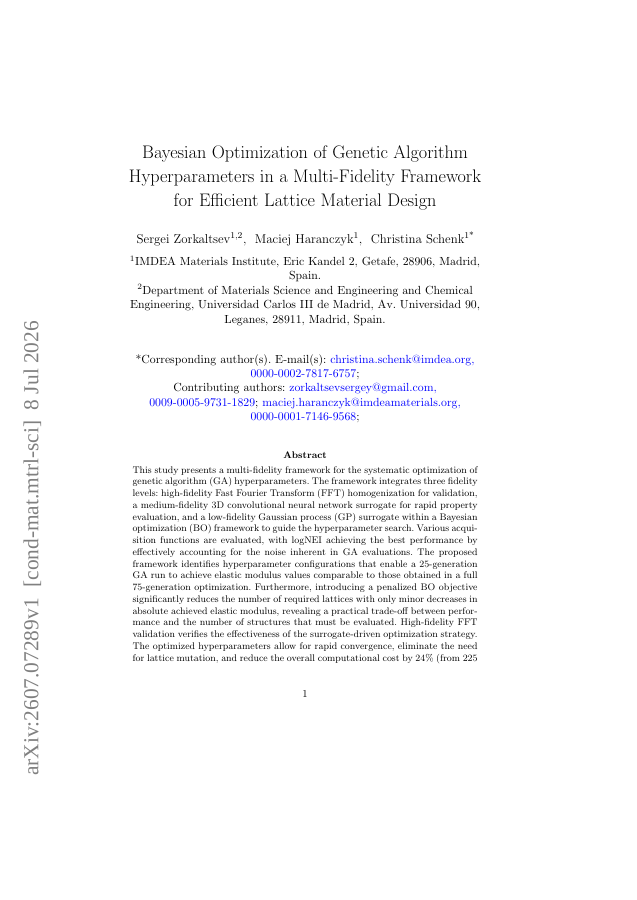
This study presents a multi-fidelity framework for the systematic optimization of genetic algorithm (GA) hyperparameters. The framework integrates three fidelity levels: high-fidelity Fast Fourier Transform (FFT) homogenization for validation, a medium-fidelity 3D convolutional neural network surrogate for rapid property evaluation, and a low-fidelity Gaussian process (GP) surrogate within a Bayesian optimization (BO) framework to guide the hyperparameter search. Various acquisition functions are evaluated, with logNEI achieving the best performance by effectively accounting for the noise inherent in GA evaluations. The proposed framework identifies hyperparameter configurations that enable a 25-generation GA run to achieve elastic modulus values comparable to those obtained in a full 75-generation optimization. Furthermore, introducing a penalized BO objective significantly reduces the number of required lattices with only minor decreases in absolute achieved elastic modulus, revealing a practical trade-off between performance and the number of structures that must be evaluated. High-fidelity FFT validation verifies the effectiveness of the surrogate-driven optimization strategy. The optimized hyperparameters allow for rapid convergence, eliminate the need for lattice mutation, and reduce the overall computational cost by 24% (from 225 to 171 hours) while preserving mechanical performance. These results demonstrate the potential of multi-fidelity optimization as an efficient and practical approach for GA hyperparameter tuning and future experimental lattice design studies.
Bayesian Optimization of Genetic Algorithm Hyperparameters in a Multi-Fidelity Framework for Efficient Lattice Material Design
This study presents a multi-fidelity framework for the systematic optimization of genetic algorithm (GA) hyperparameters. The framework integrates three fidelity levels: high-fidelity Fast Fourier Transform (FFT) homogenization for validation, a medium-fidelity 3D convolutional…
- Preview
- Year
- 2026
- Hosting
- Full text hostedCC-BY-4.0
Cite
Notes
Only stored in your browser.
Attribution
- Abstract & full text
- arxiv.org/abs/2607.07289CC-BY-4.0
- TL;DR
- Semantic Scholar