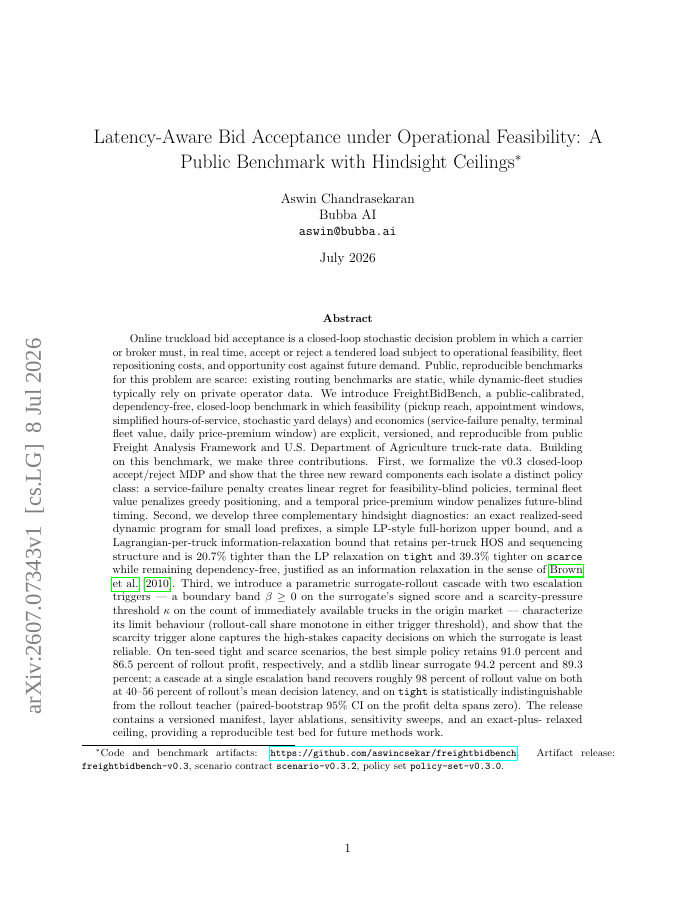
Online truckload bid acceptance is a closed-loop stochastic decision problem in which a carrier or broker must, in real time, accept or reject a tendered load subject to operational feasibility, fleet repositioning costs, and opportunity cost against future demand. Public, reproducible benchmarks for this problem are scarce: existing routing benchmarks are static, while dynamic-fleet studies typically rely on private operator data. We introduce FreightBidBench, a public-calibrated, dependency-free, closed-loop benchmark in which feasibility (pickup reach, appointment windows, simplified hours-of-service, stochastic yard delays) and economics (service-failure penalty, terminal fleet value, daily price-premium window) are explicit, versioned, and reproducible from public Freight Analysis Framework and U.S. Department of Agriculture truck rate data. We develop two full-horizon hindsight ceilings: a simple LP style relaxation and a tighter Lagrangian-per-truck information relaxation that retains per-truck hours-of-service and sequencing structure and is 20.7% tighter than the LP relaxation on a tight-capacity scenario and 39.3% tighter on a scarce-capacity scenario. We introduce a parametric surrogate-rollout cascade with boundary-band and scarcity-pressure escalation triggers. On ten-seed tight and scarce scenarios, the best simple policy retains 91.0% and 86.5% of rollout profit and the standard-library surrogate 94.2% and 89.3%; a cascade at a single escalation band recovers roughly 98% on both at 40-56% of rollout's mean decision latency, and on the tight scenario is statistically indistinguishable from the rollout teacher (paired-bootstrap 95% CI on the profit delta spans zero).
Latency-Aware Bid Acceptance under Operational Feasibility: A Public Benchmark with Hindsight Ceilings
Online truckload bid acceptance is a closed-loop stochastic decision problem in which a carrier or broker must, in real time, accept or reject a tendered load subject to operational feasibility, fleet repositioning costs, and opportunity cost against future demand.
- Preview
- Year
- 2026
- Hosting
- Full text hostedCC-BY-4.0
Cite
Notes
Only stored in your browser.
Attribution
- Abstract & full text
- arxiv.org/abs/2607.07343CC-BY-4.0
- TL;DR
- Semantic Scholar