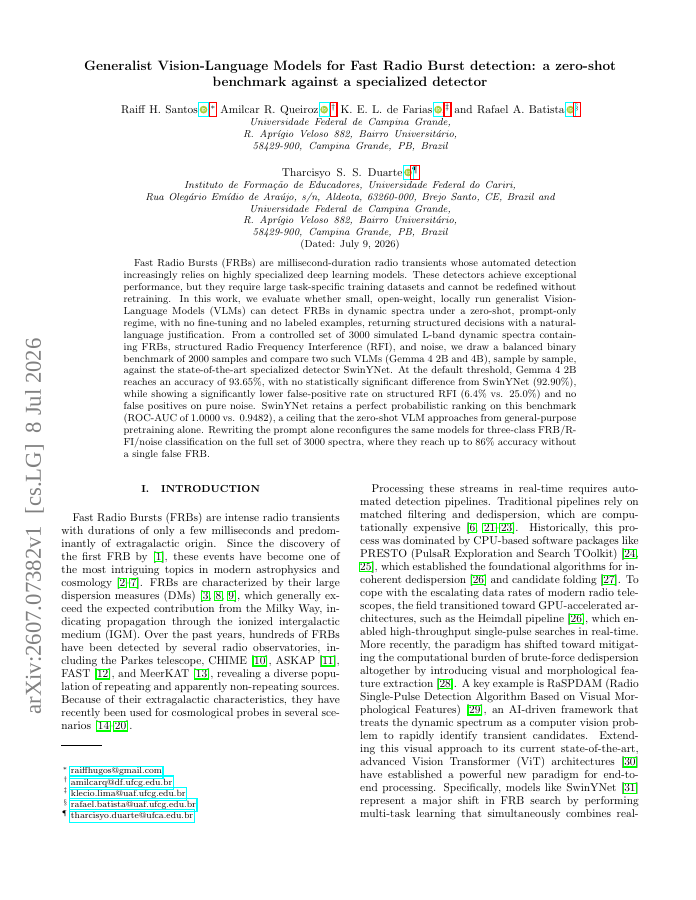
Fast Radio Bursts (FRBs) are millisecond-duration radio transients whose automated detection increasingly relies on highly specialized deep learning models. These detectors achieve exceptional performance, but they require large task-specific training datasets and cannot be redefined without retraining. In this work, we evaluate whether small, open-weight, locally run generalist Vision-Language Models (VLMs) can detect FRBs in dynamic spectra under a zero-shot, prompt-only regime, with no fine-tuning and no labeled examples, returning structured decisions with a natural-language justification. From a controlled set of 3000 simulated L-band dynamic spectra containing FRBs, structured Radio Frequency Interference (RFI), and noise, we draw a balanced binary benchmark of 2000 samples and compare two such VLMs (Gemma 4 2B and 4B), sample by sample, against the state-of-the-art specialized detector SwinYNet. At the default threshold, Gemma 4 2B reaches an accuracy of 93.65%, with no statistically significant difference from SwinYNet (92.90%), while showing a significantly lower false-positive rate on structured RFI (6.4% vs. 25.0%) and no false positives on pure noise. SwinYNet retains a perfect probabilistic ranking on this benchmark (ROC-AUC of 1.0000 vs. 0.9482), a ceiling that the zero-shot VLM approaches from general-purpose pretraining alone. Rewriting the prompt alone reconfigures the same models for three-class FRB/RFI/noise classification on the full set of 3000 spectra, where they reach up to 86% accuracy without a single false FRB.
Generalist Vision-Language Models for Fast Radio Burst detection: a zero-shot benchmark against a specialized detector
Fast Radio Bursts (FRBs) are millisecond-duration radio transients whose automated detection increasingly relies on highly specialized deep learning models. These detectors achieve exceptional performance, but they require large task-specific training datasets and cannot be…
- Preview
- Year
- 2026
- Hosting
- Full text hostedCC-BY-4.0
Cite
Notes
Only stored in your browser.
Attribution
- Abstract & full text
- arxiv.org/abs/2607.07382CC-BY-4.0
- TL;DR
- Semantic Scholar