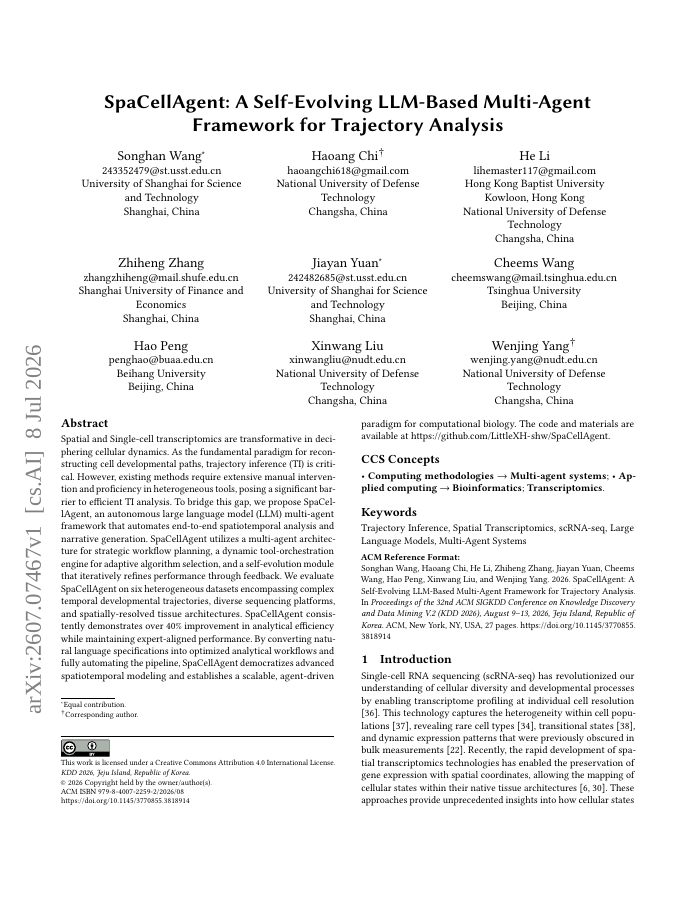
Spatial and Single-cell transcriptomics are transformative in deciphering cellular dynamics. As the fundamental paradigm for reconstructing cell developmental paths, trajectory inference (TI) is critical. However, existing methods require extensive manual intervention and proficiency in heterogeneous tools, posing a significant barrier to efficient TI analysis. To bridge this gap, we propose SpaCellAgent, an autonomous large language model (LLM) multi-agent framework that automates end-to-end spatiotemporal analysis and narrative generation. SpaCellAgent utilizes a multi-agent architecture for strategic workflow planning, a dynamic tool-orchestration engine for adaptive algorithm selection, and a self-evolution module that iteratively refines performance through feedback. We evaluate SpaCellAgent on six heterogeneous datasets encompassing complex temporal developmental trajectories, diverse sequencing platforms, and spatially-resolved tissue architectures. SpaCellAgent consistently demonstrates over 40% improvement in analytical efficiency while maintaining expert-aligned performance. By converting natural language specifications into optimized analytical workflows and fully automating the pipeline, SpaCellAgent democratizes advanced spatiotemporal modeling and establishes a scalable, agent-driven paradigm for computational biology. The code and materials are available at https://github.com/LittleXH-shw/SpaCellAgent.
SpaCellAgent: A Self-Evolving LLM-Based Multi-Agent Framework for Trajectory Analysis
Spatial and Single-cell transcriptomics are transformative in deciphering cellular dynamics. As the fundamental paradigm for reconstructing cell developmental paths, trajectory inference (TI) is critical.
- Preview
- Year
- 2026
- Hosting
- Abstract onlyARXIV-DEFAULT
Cite
Notes
Only stored in your browser.
Attribution
- Abstract & full text
- arxiv.org/abs/2607.07467ARXIV-DEFAULT
- TL;DR
- Semantic Scholar