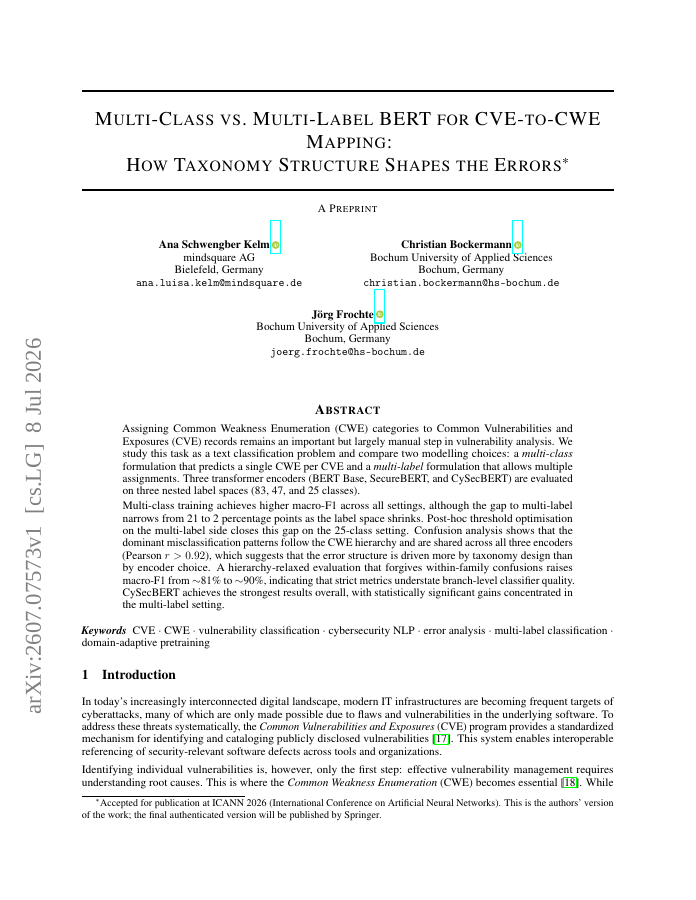
Assigning Common Weakness Enumeration (CWE) categories to Common Vulnerabilities and Exposures (CVE) records remains an important but largely manual step in vulnerability analysis. We study this task as a text classification problem and compare two modelling choices: a multi-class formulation that predicts a single CWE per CVE and a multi-label formulation that allows multiple assignments. Three transformer encoders (BERT Base, SecureBERT, and CySecBERT) are evaluated on three nested label spaces (83, 47, and 25 classes). Multi-class training achieves higher macro-F1 across all settings, although the gap to multi-label narrows from 21 to 2 percentage points as the label space shrinks. Post-hoc threshold optimisation on the multi-label side closes this gap on the 25-class setting. Confusion analysis shows that the dominant misclassification patterns follow the CWE hierarchy and are shared across all three encoders (Pearson r > 0.92), which suggests that the error structure is driven more by taxonomy design than by encoder choice. A hierarchy-relaxed evaluation that forgives within-family confusions raises macro-F1 from {\sim}81% to {\sim}90%, indicating that strict metrics understate branch-level classifier quality. CySecBERT achieves the strongest results overall, with statistically significant gains concentrated in the multi-label setting.
Multi-Class vs. Multi-Label BERT for CVE-to-CWE Mapping: How Taxonomy Structure Shapes the Errors
Assigning Common Weakness Enumeration (CWE) categories to Common Vulnerabilities and Exposures (CVE) records remains an important but largely manual step in vulnerability analysis.
- Preview
- Year
- 2026
- Hosting
- Abstract onlyARXIV-DEFAULT
Cite
Notes
Only stored in your browser.
Attribution
- Abstract & full text
- arxiv.org/abs/2607.07573ARXIV-DEFAULT
- TL;DR
- Semantic Scholar