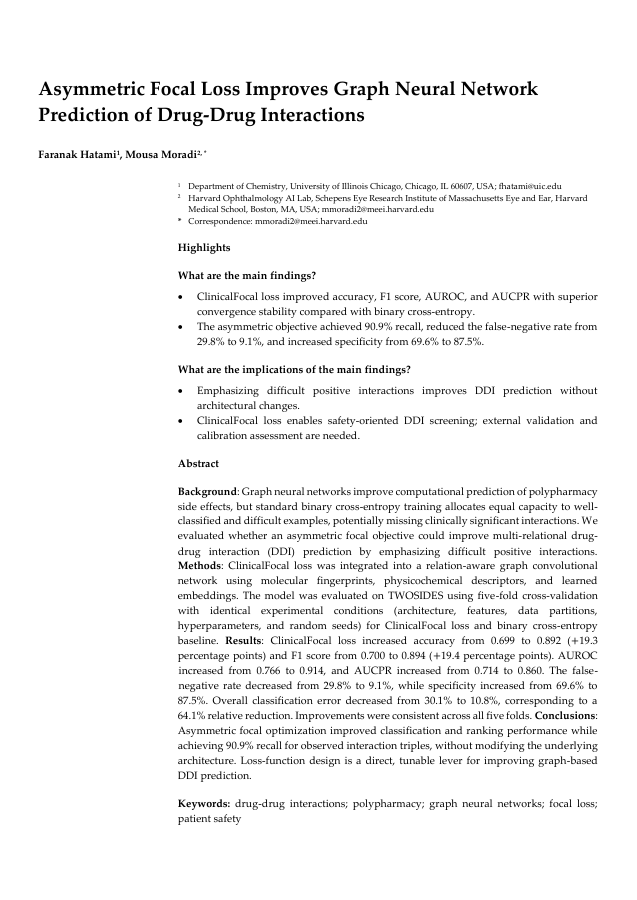
Background: Graph neural networks improve computational prediction of polypharmacy side effects, but standard binary cross-entropy training allocates equal capacity to well-classified and difficult examples, potentially missing clinically significant interactions. We evaluated whether an asymmetric focal objective could improve multi-relational drug-drug interaction (DDI) prediction by emphasizing difficult positive interactions. Methods: ClinicalFocal loss was integrated into a relation-aware graph convolutional network using molecular fingerprints, physicochemical descriptors, and learned embeddings. The model was evaluated on TWOSIDES using five-fold cross-validation with identical experimental conditions (architecture, features, data partitions, hyperparameters, and random seeds) for ClinicalFocal loss and binary cross-entropy baseline. Results: ClinicalFocal loss increased accuracy from 0.699 to 0.892 (+19.3 percentage points) and F1 score from 0.700 to 0.894 (+19.4 percentage points). AUROC increased from 0.766 to 0.914, and AUCPR increased from 0.714 to 0.860. The false-negative rate decreased from 29.8% to 9.1%, while specificity increased from 69.6% to 87.5%. Overall classification error decreased from 30.1% to 10.8%, corresponding to a 64.1% relative reduction. Improvements were consistent across all five folds. Conclusions: Asymmetric focal optimization improved classification and ranking performance while achieving 90.9% recall for observed interaction triples, without modifying the underlying architecture. Loss-function design is a direct, tunable lever for improving graph-based DDI prediction.
Asymmetric Focal Loss Improves Graph Neural Network Prediction of Drug-Drug Interactions
Background: Graph neural networks improve computational prediction of polypharmacy side effects, but standard binary cross-entropy training allocates equal capacity to well-classified and difficult examples, potentially missing clinically significant interactions.
- Preview
- Year
- 2026
- Hosting
- Full text hostedCC-BY-4.0
Cite
Notes
Only stored in your browser.
Attribution
- Abstract & full text
- arxiv.org/abs/2607.07611CC-BY-4.0
- TL;DR
- Semantic Scholar