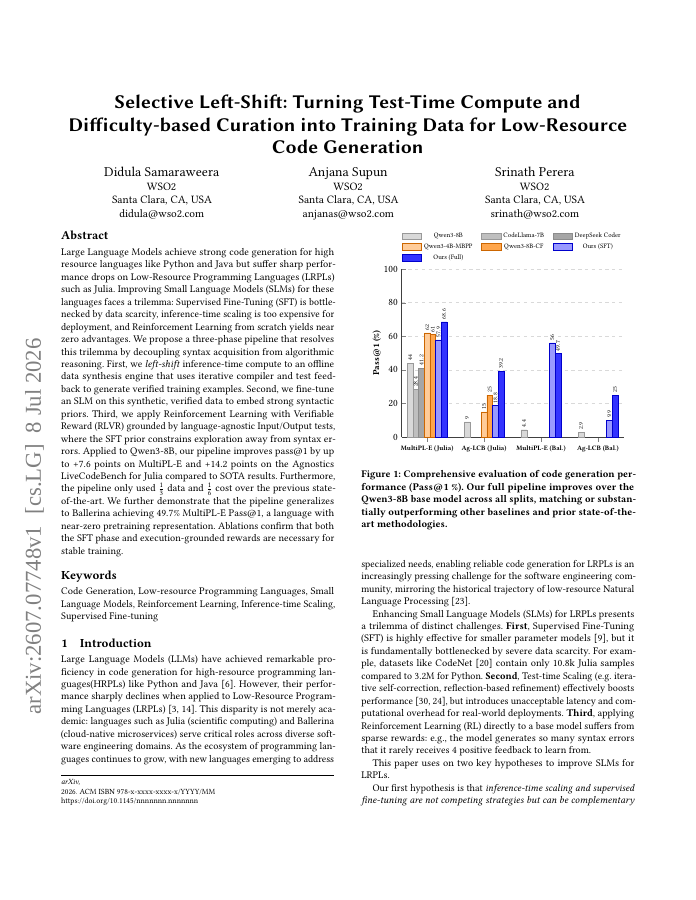
Large Language Models achieve strong code generation for high resource languages like Python and Java but suffer sharp performance drops on Low-Resource Programming Languages (LRPLs) such as Julia. Improving Small Language Models (SLMs) for these languages faces a trilemma: Supervised Fine-Tuning (SFT) is bottlenecked by data scarcity, inference-time scaling is too expensive for deployment, and Reinforcement Learning from scratch yields near zero advantages. We propose a three-phase pipeline that resolves this trilemma by decoupling syntax acquisition from algorithmic reasoning. First, we left-shift inference-time compute to an offline data synthesis engine that uses iterative compiler and test feedback to generate verified training examples. Second, we fine-tune an SLM on this synthetic, verified data to embed strong syntactic priors. Third, we apply Reinforcement Learning with Verifiable Reward (RLVR) grounded by language-agnostic Input/Output tests, where the SFT prior constrains exploration away from syntax errors. Applied to Qwen3-8B, our pipeline improves pass@1 by up to +7.6 points on MultiPL-E and +14.2 points on the Agnostics LiveCodeBench for Julia compared to SOTA results. Furthermore, the pipeline only used \frac{1}{3} data and \frac{1}{6} cost over the previous state-of-the-art. We further demonstrate that the pipeline generalizes to Ballerina achieving 49.7% MultiPL-E Pass@1, a language with near-zero pretraining representation. Ablations confirm that both the SFT phase and execution-grounded rewards are necessary for stable training.
Selective Left-Shift: Turning Test-Time Compute and Difficulty-based Curation into Training Data for Low-Resource Code Generation
Large Language Models achieve strong code generation for high resource languages like Python and Java but suffer sharp performance drops on Low-Resource Programming Languages~(LRPLs) such as Julia.
- Preview
- Year
- 2026
- Hosting
- Full text hostedCC-BY-4.0
Cite
Notes
Only stored in your browser.
Attribution
- Abstract & full text
- arxiv.org/abs/2607.07748CC-BY-4.0
- TL;DR
- Semantic Scholar