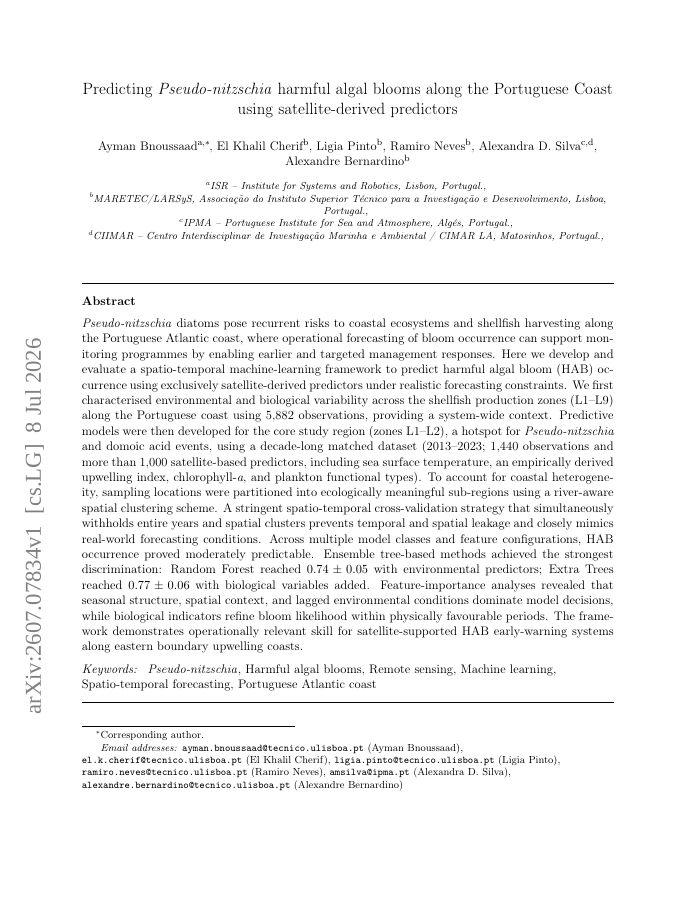
Pseudo-nitzschia diatoms pose recurrent risks to coastal ecosystems and shellfish harvesting along the Portuguese Atlantic coast. Here we develop and evaluate a spatio-temporal machine-learning framework to predict harmful algal bloom (HAB) occurrence using exclusively satellite-derived predictors under realistic forecasting constraints. We characterised environmental and biological variability across shellfish production zones (L1-L9) using 5,882 observations, providing system-wide context. Predictive models were developed for zones L1-L2, a hotspot for Pseudo-nitzschia and domoic acid events, using a decade-long dataset (2013-2023; 1,440 observations; more than 1,000 satellite-based predictors including sea surface temperature, an upwelling index, chlorophyll-a, and plankton functional types). Sampling locations were partitioned into ecologically meaningful sub-regions using a river-aware spatial clustering scheme. A stringent spatio-temporal cross-validation strategy that simultaneously withholds entire years and spatial clusters prevents leakage and closely mimics real-world forecasting conditions. HAB occurrence proved moderately predictable across model classes and feature configurations. Ensemble tree-based methods achieved the strongest discrimination: Random Forest reached 0.74 +/- 0.05 with environmental predictors; Extra Trees reached 0.77 +/- 0.06 with biological variables added. Feature-importance analyses revealed that seasonal structure, spatial context, and lagged environmental conditions dominate model decisions, while biological indicators refine bloom likelihood within physically favourable periods. The framework demonstrates operationally relevant skill for satellite-supported HAB early-warning systems along eastern boundary upwelling coasts.
Predicting Pseudo-nitzschia harmful algal blooms along the Portuguese Coast using satellite-derived predictors
Pseudo-nitzschia diatoms pose recurrent risks to coastal ecosystems and shellfish harvesting along the Portuguese Atlantic coast. Here we develop and evaluate a spatio-temporal machine-learning framework to predict harmful algal bloom (HAB) occurrence using exclusively…
- Preview
- Year
- 2026
- Hosting
- Abstract onlyARXIV-DEFAULT
Cite
Notes
Only stored in your browser.
Attribution
- Abstract & full text
- arxiv.org/abs/2607.07834ARXIV-DEFAULT
- TL;DR
- Semantic Scholar