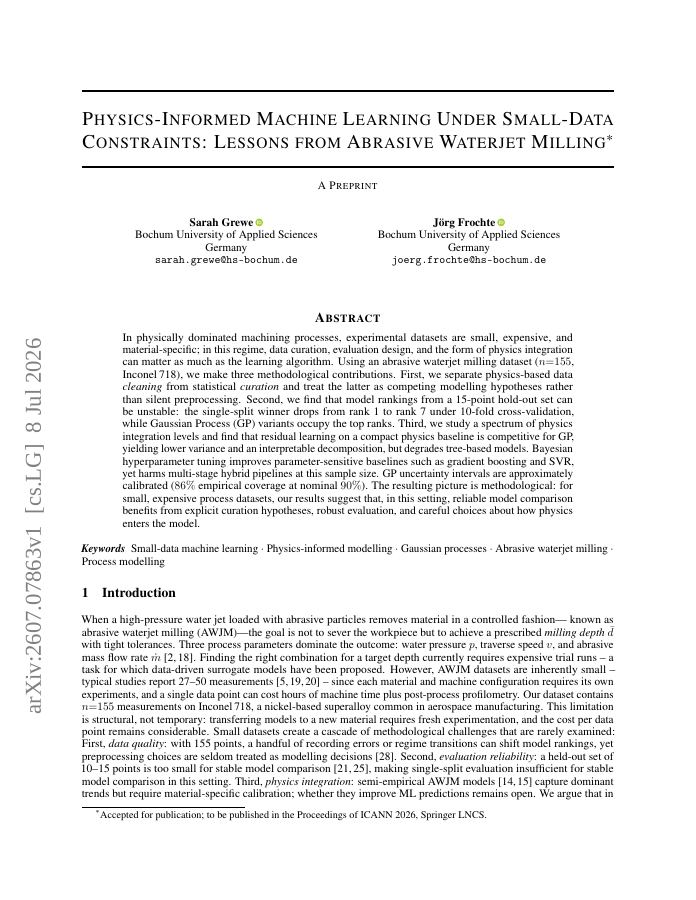
In physically dominated machining processes, experimental datasets are small, expensive, and material-specific; in this regime, data curation, evaluation design, and the form of physics integration can matter as much as the learning algorithm. Using an abrasive waterjet milling dataset (n{=}155, Inconel,718), we make three methodological contributions. First, we separate physics-based data cleaning from statistical curation and treat the latter as competing modelling hypotheses rather than silent preprocessing. Second, we find that model rankings from a 15-point hold-out set can be unstable: the single-split winner drops from rank 1 to rank 7 under 10-fold cross-validation, while Gaussian Process (GP) variants occupy the top ranks. Third, we study a spectrum of physics integration levels and find that residual learning on a compact physics baseline is competitive for GP, yielding lower variance and an interpretable decomposition, but degrades tree-based models. Bayesian hyper parameter tuning improves parameter-sensitive baselines such as gradient boosting and SVR, yet harms multi-stage hybrid pipelines at this sample size. GP uncertainty intervals are approximately calibrated (86% empirical coverage at nominal 90%). The resulting picture is methodological: for small, expensive process datasets, our results suggest that, in this setting, reliable model comparison benefits from explicit curation hypotheses, robust evaluation, and careful choices about how physics enters the model.
Physics-Informed Machine Learning Under Small-Data Constraints: Lessons from Abrasive Waterjet Milling
In physically dominated machining processes, experimental datasets are small, expensive, and material-specific; in this regime, data curation, evaluation design, and the form of physics integration can matter as much as the learning algorithm.
- Preview
- Year
- 2026
- Hosting
- Abstract onlyARXIV-DEFAULT
Cite
Notes
Only stored in your browser.
Attribution
- Abstract & full text
- arxiv.org/abs/2607.07863ARXIV-DEFAULT
- TL;DR
- Semantic Scholar