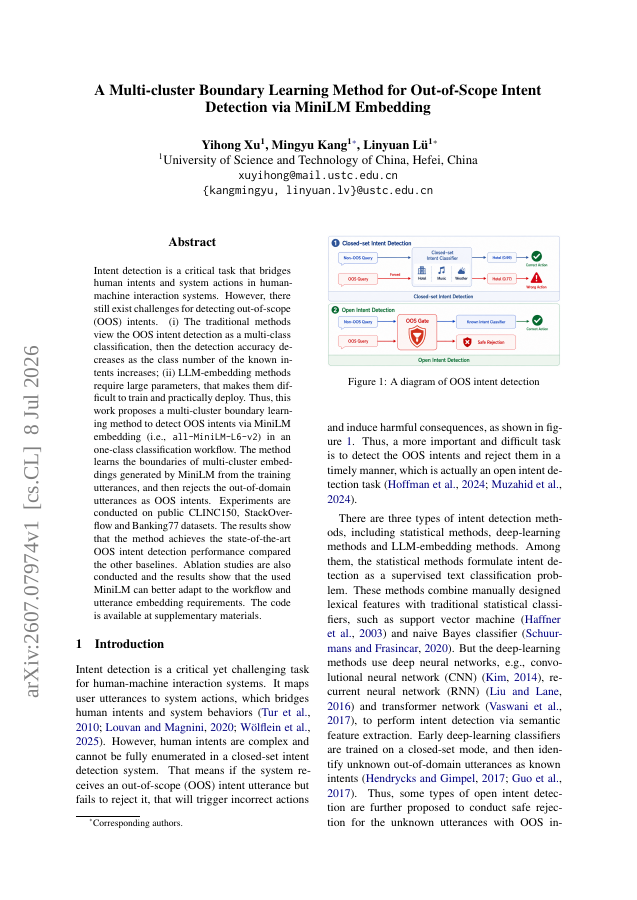
Intent detection is a critical task that bridges human intents and system actions in human-machine interaction systems. However, there still exist challenges for detecting out-of-scope (OOS) intents. (i) The traditional methods view the OOS intent detection as a multi-class classification, then the detection accuracy decreases as the class number of the known intents increases; (ii) LLM-embedding methods require large parameters, that makes them difficult to train and practically deploy. Thus, this work proposes a multi-cluster boundary learning method to detect OOS intents via MiniLM embedding (i.e., all-MiniLM-L6-v2) in an one-class classification workflow. The method learns the boundaries of multi-cluster embeddings generated by MiniLM from the training utterances, and then rejects the out-of-domain utterances as OOS intents. Experiments are conducted on public CLINC150, StackOverflow and Banking77 datasets. The results show that the method achieves the state-of-the-art OOS intent detection performance compared the other baselines. Ablation studies are also conducted and the results show that the used MiniLM can better adapt to the workflow and utterance embedding requirements. The code is available at supplementary materials.
A Multi-cluster Boundary Learning Method for Out-of-Scope Intent Detection via MiniLM Embedding
Intent detection is a critical task that bridges human intents and system actions in human-machine interaction systems. However, there still exist challenges for detecting out-of-scope (OOS) intents.
- Preview
- Year
- 2026
- Hosting
- Abstract onlyARXIV-DEFAULT
Cite
Notes
Only stored in your browser.
Attribution
- Abstract & full text
- arxiv.org/abs/2607.07974ARXIV-DEFAULT
- TL;DR
- Semantic Scholar