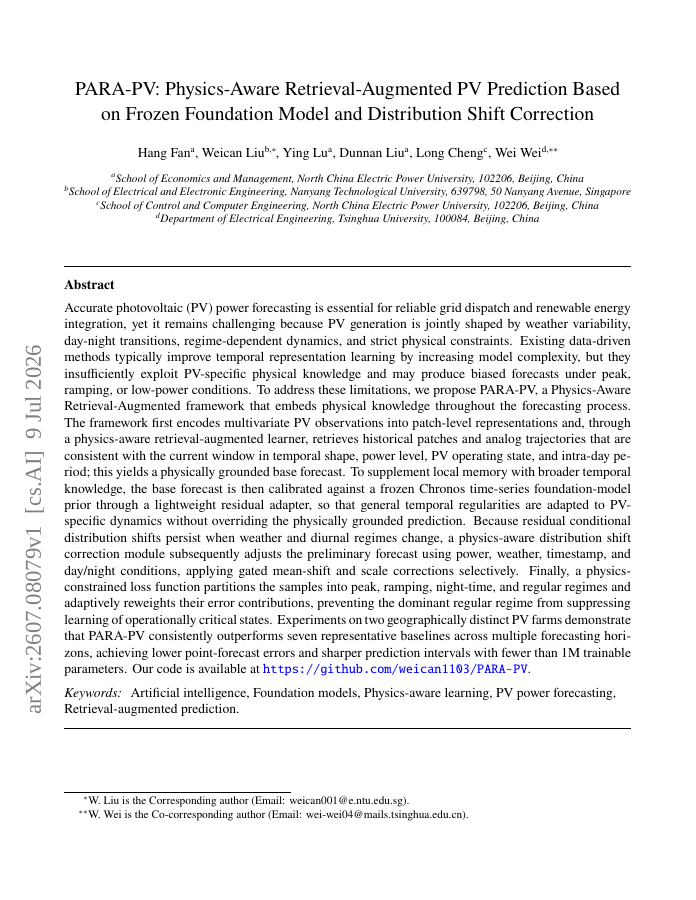
Accurate photovoltaic (PV) power forecasting is essential for reliable grid dispatch and renewable energy integration, yet it remains challenging because PV generation is jointly shaped by weather variability, day-night transitions, regime-dependent dynamics, and strict physical constraints. We propose PARA-PV, a Physics-Aware Retrieval-Augmented framework that embeds physical knowledge throughout the forecasting process. The framework first encodes multivariate PV observations into patch-level representations and, through a physics-aware retrieval-augmented learner, retrieves historical patches and analog trajectories that are consistent with the current window in temporal shape, power level, PV operating state, and intra-day period; this yields a physically grounded base forecast. To supplement local memory with broader temporal knowledge, the base forecast is then calibrated against a frozen Chronos time-series foundation-model prior through a lightweight residual adapter, so that general temporal regularities are adapted to PV-specific dynamics without overriding the physically grounded prediction. Because residual conditional distribution shifts persist when weather and diurnal regimes change, a physics-aware distribution shift correction module subsequently adjusts the preliminary forecast using power, weather, timestamp, and day/night conditions, applying gated mean-shift and scale corrections selectively. Finally, a physics-constrained loss function partitions the samples into peak, ramping, night-time, and regular regimes and adaptively reweights their error contributions, preventing the dominant regular regime from suppressing learning of operationally critical states. Our code is available at https://github.com/weican1103/PARA-PV.
PARA-PV: Physics-Aware Retrieval-Augmented PV Prediction Based on Frozen Foundation Model and Distribution Shift Correction
Accurate photovoltaic (PV) power forecasting is essential for reliable grid dispatch and renewable energy integration, yet it remains challenging because PV generation is jointly shaped by weather variability, day-night transitions, regime-dependent dynamics, and strict physical…
- Preview
- Year
- 2026
- Hosting
- Abstract onlyARXIV-DEFAULT
Cite
Notes
Only stored in your browser.
Attribution
- Abstract & full text
- arxiv.org/abs/2607.08079ARXIV-DEFAULT
- TL;DR
- Semantic Scholar