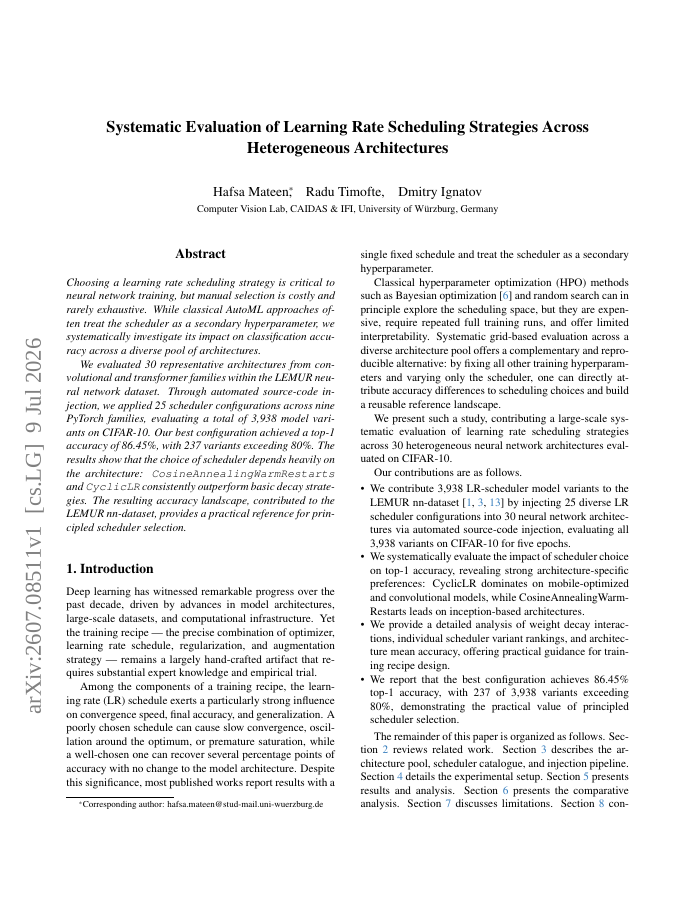
Choosing a learning rate scheduling strategy is critical to neural network training, but manual selection is costly and rarely exhaustive. While classical AutoML approaches often treat the scheduler as a secondary hyperparameter, we systematically investigate its impact on classification accuracy across a diverse pool of architectures. We evaluated 30 representative architectures from convolutional and transformer families within the LEMUR neural network dataset. Through automated source-code injection, we applied 25 scheduler configurations across nine PyTorch families, evaluating a total of 3,938 model variants on CIFAR-10. Our best configuration achieved a top-1 accuracy of 86.45%, with 237 variants exceeding 80%. The results show that the choice of scheduler depends heavily on the architecture: CosineAnnealingWarmRestarts and CyclicLR consistently outperform basic decay strategies. The resulting accuracy landscape, contributed to the LEMUR nn-dataset, provides a practical reference for principled scheduler selection.
Systematic Evaluation of Learning Rate Scheduling Strategies Across Heterogeneous Architectures
Choosing a learning rate scheduling strategy is critical to neural network training, but manual selection is costly and rarely exhaustive. While classical AutoML approaches often treat the scheduler as a secondary hyperparameter, we systematically investigate its impact on…
- Preview
- Year
- 2026
- Hosting
- Abstract onlyARXIV-DEFAULT
Cite
Notes
Only stored in your browser.
Attribution
- Abstract & full text
- arxiv.org/abs/2607.08511ARXIV-DEFAULT
- TL;DR
- Semantic Scholar