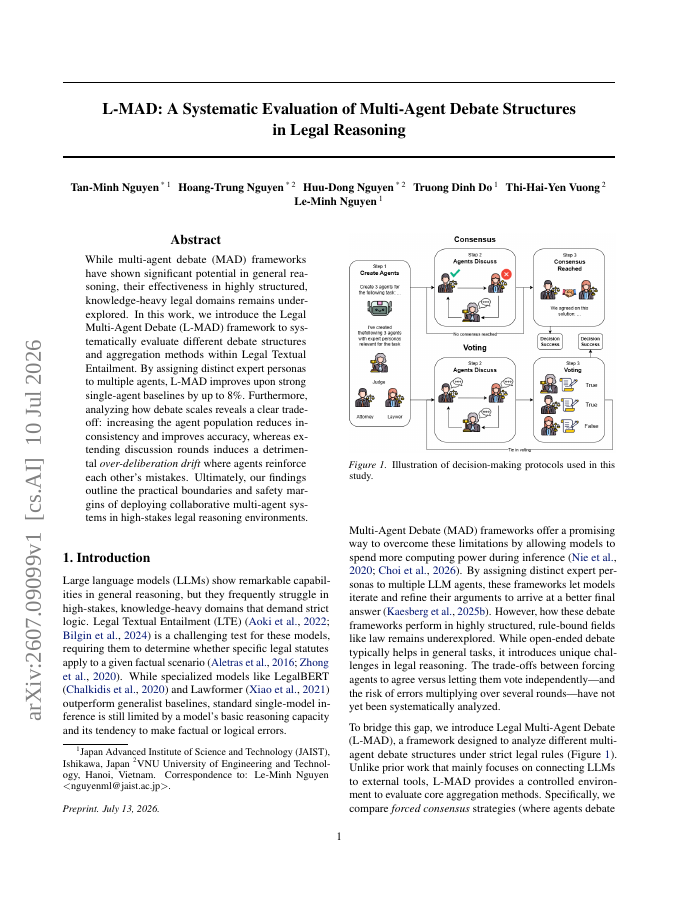
While multi-agent debate (MAD) frameworks have shown significant potential in general reasoning, their effectiveness in highly structured, knowledge-heavy legal domains remains under-explored. In this work, we introduce the Legal Multi-Agent Debate (L-MAD) framework to systematically evaluate different debate structures and aggregation methods within Legal Textual Entailment. By assigning distinct expert personas to multiple agents, L-MAD improves upon strong single-agent baselines by up to 8%. Furthermore, analyzing how debate scales reveals a clear trade-off: increasing the agent population reduces inconsistency and improves accuracy, whereas extending discussion rounds induces a detrimental over-deliberation drift where agents reinforce each other's mistakes. Ultimately, our findings outline the practical boundaries and safety margins of deploying collaborative multi-agent systems in high-stakes legal reasoning environments.
L-MAD: A Systematic Evaluation of Multi-Agent Debate Structures in Legal Reasoning
While multi-agent debate (MAD) frameworks have shown significant potential in general reasoning, their effectiveness in highly structured, knowledge-heavy legal domains remains under-explored.
- Preview
- Year
- 2026
- Hosting
- Full text hostedCC-BY-4.0
Cite
Notes
Only stored in your browser.
Attribution
- Abstract & full text
- arxiv.org/abs/2607.09099CC-BY-4.0
- TL;DR
- Semantic Scholar