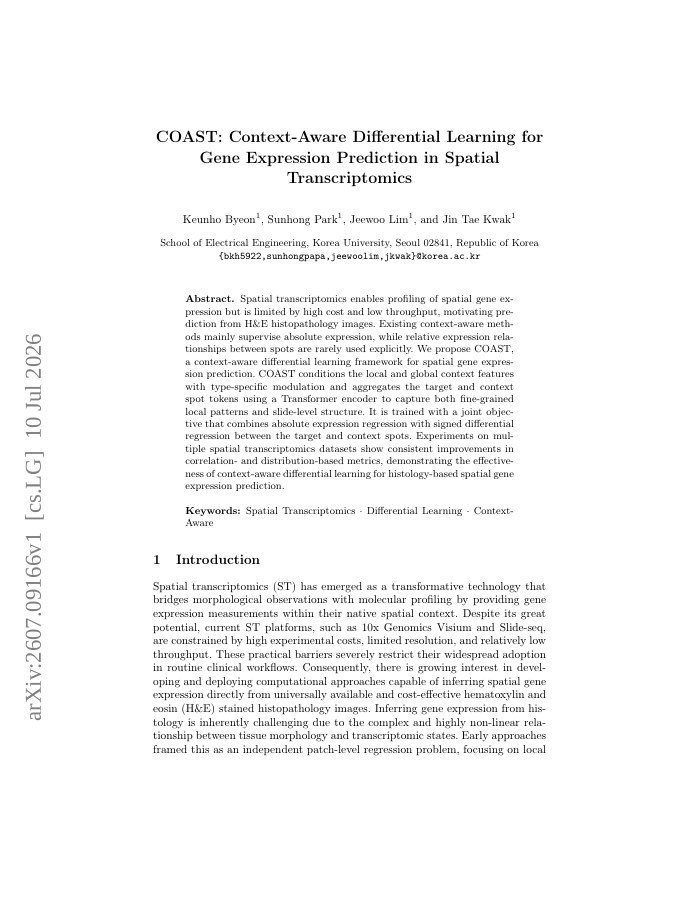
Spatial transcriptomics enables profiling of spatial gene expression but is limited by high cost and low throughput, motivating prediction from H&E histopathology images. Existing context-aware methods mainly supervise absolute expression, while relative expression relationships between spots are rarely used explicitly. We propose COAST, a context-aware differential learning framework for spatial gene expression prediction. COAST conditions the local and global context features with type-specific modulation and aggregates the target and context spot tokens using a Transformer encoder to capture both fine-grained local patterns and slide-level structure. It is trained with a joint objective that combines absolute expression regression with signed differential regression between the target and context spots. Experiments on multiple spatial transcriptomics datasets show consistent improvements in correlation- and distribution-based metrics, demonstrating the effectiveness of context-aware differential learning for histology-based spatial gene expression prediction.
COAST: Context-Aware Differential Learning for Gene Expression Prediction in Spatial Transcriptomics
Spatial transcriptomics enables profiling of spatial gene expression but is limited by high cost and low throughput, motivating prediction from H&E histopathology images.
- Preview
- Year
- 2026
- Hosting
- Excerpt onlyCC-BY-NC-SA-4.0
Cite
Notes
Only stored in your browser.
Attribution
- Abstract & full text
- arxiv.org/abs/2607.09166CC-BY-NC-SA-4.0
- TL;DR
- Semantic Scholar