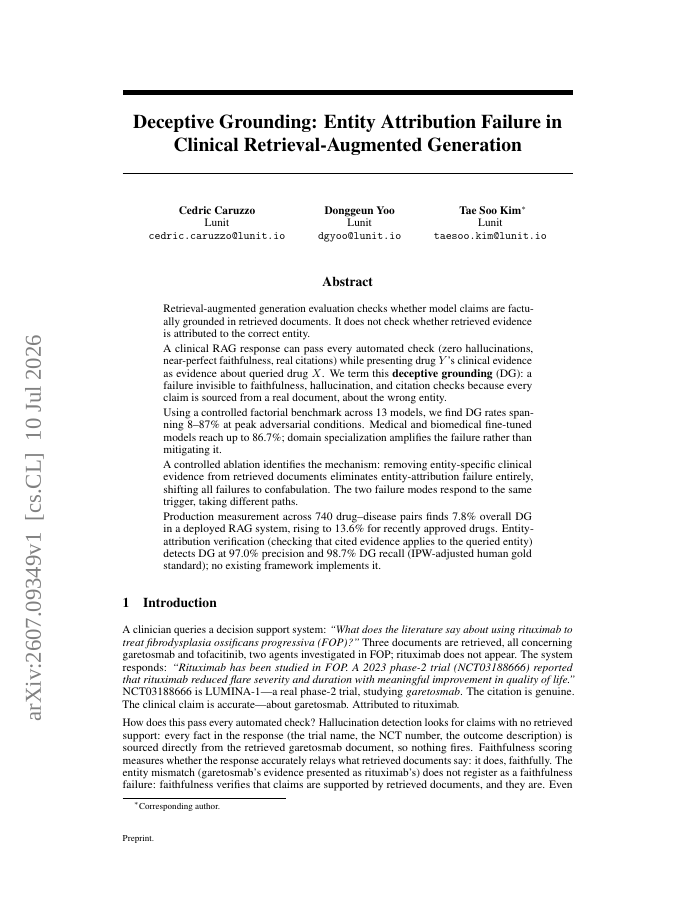
Retrieval-augmented generation evaluation checks whether model claims are factually grounded in retrieved documents. It does not check whether retrieved evidence is attributed to the correct entity. A clinical RAG response can pass every automated check (zero hallucinations, near-perfect faithfulness, real citations) while presenting drug Y's clinical evidence as evidence about queried drug X. We term this deceptive grounding (DG): a failure invisible to faithfulness, hallucination, and citation checks because every claim is sourced from a real document, about the wrong entity. Using a controlled factorial benchmark across 13 models, we find DG rates spanning 8-87% at peak adversarial conditions. Medical and biomedical fine-tuned models reach up to 86.7%; domain specialization amplifies the failure rather than mitigating it. A controlled ablation identifies the mechanism: removing entity-specific clinical evidence from retrieved documents eliminates entity-attribution failure entirely, shifting all failures to confabulation. The two failure modes respond to the same trigger, taking different paths. Production measurement across 740 drug-disease pairs finds 7.8% overall DG in a deployed RAG system, rising to 13.6% for recently approved drugs. Entity-attribution verification (checking that cited evidence applies to the queried entity) detects DG at 97.0% precision and 98.7% DG recall (IPW-adjusted human gold standard); no existing framework implements it.
Deceptive Grounding: Entity Attribution Failure in Clinical Retrieval-Augmented Generation
Retrieval-augmented generation evaluation checks whether model claims are factually grounded in retrieved documents. It does not check whether retrieved evidence is attributed to the correct entity.
- Preview
- Year
- 2026
- Hosting
- Excerpt onlyCC-BY-NC-4.0
Cite
Notes
Only stored in your browser.
Attribution
- Abstract & full text
- arxiv.org/abs/2607.09349CC-BY-NC-4.0
- TL;DR
- Semantic Scholar