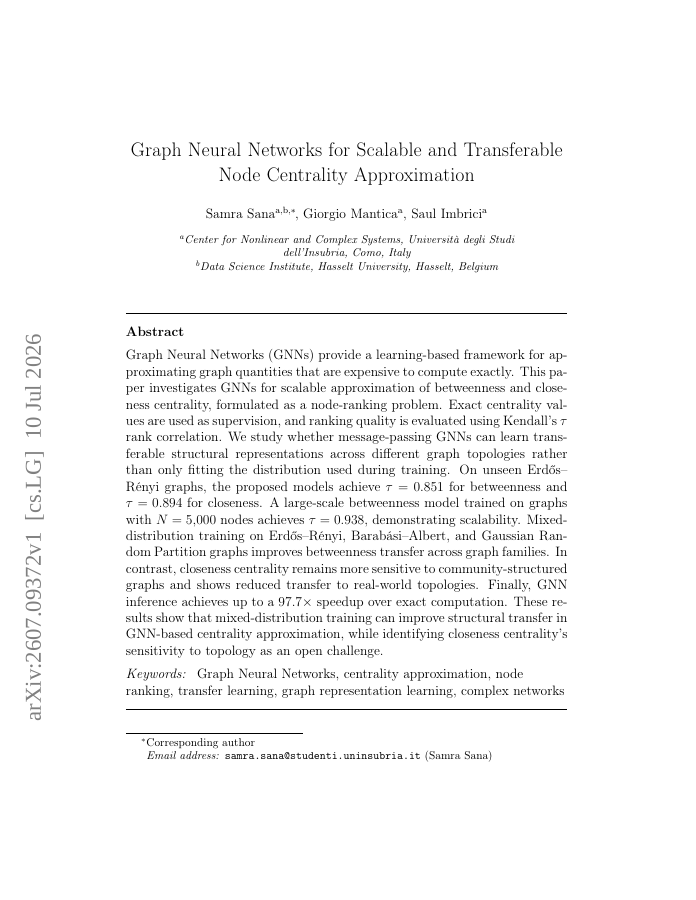
Graph Neural Networks (GNNs) provide a learning-based framework for approximating graph quantities that are expensive to compute exactly. This paper investigates GNNs for scalable approximation of betweenness and closeness centrality, formulated as a node-ranking problem. Exact centrality values are used as supervision, and ranking quality is evaluated using Kendall's tau rank correlation. We study whether message-passing GNNs can learn transferable structural representations across different graph topologies rather than only fitting the distribution used during training. On unseen Erdos renyi graphs, the proposed models achieve tau = 0.851 for betweenness and tau = 0.894 for closeness. A large-scale betweenness model trained on graphs with N = 5,000 nodes achieves tau = 0.938, demonstrating scalability. Mixed-distribution training on Erdos renyi, Barabasi-Albert, and Gaussian Random Partition graphs improves betweenness transfer across graph families. In contrast, closeness centrality remains more sensitive to community-structured graphs and shows reduced transfer to real-world topologies. Finally, GNN inference achieves up to a 97.7x speedup over exact computation. These results show that mixed-distribution training can improve structural transfer in GNN-based centrality approximation, while identifying closeness centrality's sensitivity to topology as an open challenge.
Graph Neural Networks for Scalable and Transferable Node Centrality Approximation
Graph Neural Networks (GNNs) provide a learning-based framework for approximating graph quantities that are expensive to compute exactly. This paper investigates GNNs for scalable approximation of betweenness and closeness centrality, formulated as a node-ranking problem.
- Preview
- Year
- 2026
- Hosting
- Abstract onlyARXIV-DEFAULT
Cite
Notes
Only stored in your browser.
Attribution
- Abstract & full text
- arxiv.org/abs/2607.09372ARXIV-DEFAULT
- TL;DR
- Semantic Scholar