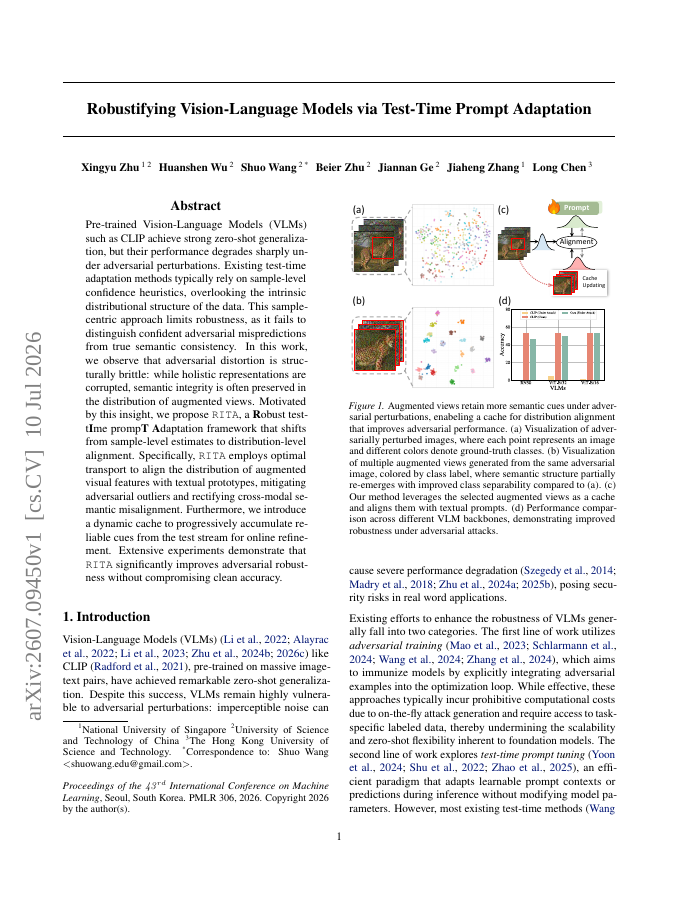
Pre-trained Vision-Language Models (VLMs) such as CLIP achieve strong zero-shot generalization, but their performance degrades sharply under adversarial perturbations. Existing test-time adaptation methods typically rely on sample-level confidence heuristics, overlooking the intrinsic distributional structure of the data. This sample-centric approach limits robustness, as it fails to distinguish confident adversarial mispredictions from true semantic consistency. In this work, we observe that adversarial distortion is structurally brittle: while holistic representations are corrupted, semantic integrity is often preserved in the distribution of augmented views. Motivated by this insight, we propose RITA, a Robust test-tIme prompt-TAdaptation framework that shifts from sample-level estimates to distribution-level alignment. Specifically, RITA employs optimal transport to align the distribution of augmented visual features with textual prototypes, mitigating adversarial outliers and rectifying cross-modal semantic misalignment. Furthermore, we introduce a dynamic cache to progressively accumulate reliable cues from the test stream for online refinement. Extensive experiments demonstrate that RITA significantly improves adversarial robustness without compromising clean accuracy.
Robustifying Vision-Language Models via Test-Time Prompt Adaptation
Pre-trained Vision-Language Models (VLMs) such as CLIP achieve strong zero-shot generalization, but their performance degrades sharply under adversarial perturbations. Existing test-time adaptation methods typically rely on sample-level confidence heuristics, overlooking the…
- Preview
- Year
- 2026
- Hosting
- Abstract onlyARXIV-DEFAULT
Cite
Notes
Only stored in your browser.
Attribution
- Abstract & full text
- arxiv.org/abs/2607.09450ARXIV-DEFAULT
- TL;DR
- Semantic Scholar