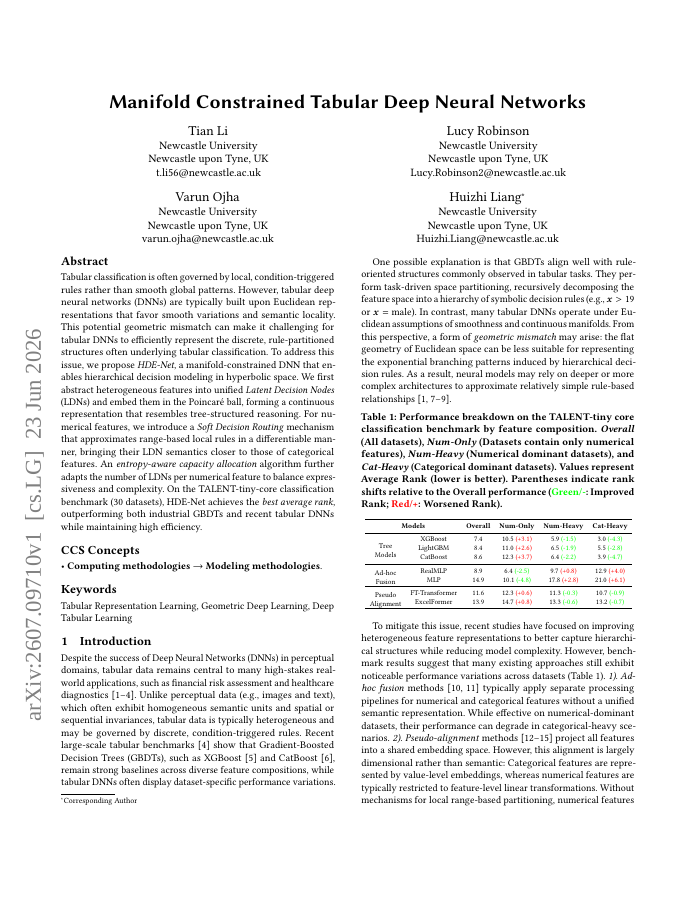
Tabular classification is often governed by local, condition-triggered rules rather than smooth global patterns. However, tabular deep neural networks (DNNs) are typically built upon Euclidean representations that favor smooth variations and semantic locality. This potential geometric mismatch can make it challenging for tabular DNNs to efficiently represent the discrete, rule-partitioned structures often underlying tabular classification. To address this issue, we propose HDE-Net, a manifold-constrained DNN that enables hierarchical decision modeling in hyperbolic space. We first abstract heterogeneous features into unified Latent Decision Nodes (LDNs) and embed them in the Poincaré ball, forming a continuous representation that resembles tree-structured reasoning. For numerical features, we introduce a Soft Decision Routing mechanism that approximates range-based local rules in a differentiable manner, bringing their LDN semantics closer to those of categorical features. An entropy-aware capacity allocation algorithm further adapts the number of LDNs per numerical feature to balance expressiveness and complexity. On the TALENT-tiny-core classification benchmark (30 datasets), HDE-Net achieves the best average rank, outperforming both industrial GBDTs and recent tabular DNNs while maintaining high efficiency.
Manifold Constrained Tabular Deep Neural Networks
Tabular classification is often governed by local, condition-triggered rules rather than smooth global patterns. However, tabular deep neural networks (DNNs) are typically built upon Euclidean representations that favor smooth variations and semantic locality.
- Preview
- Year
- 2026
- Hosting
- Abstract onlyARXIV-DEFAULT
Cite
Notes
Only stored in your browser.
Attribution
- Abstract & full text
- arxiv.org/abs/2607.09710ARXIV-DEFAULT
- TL;DR
- Semantic Scholar