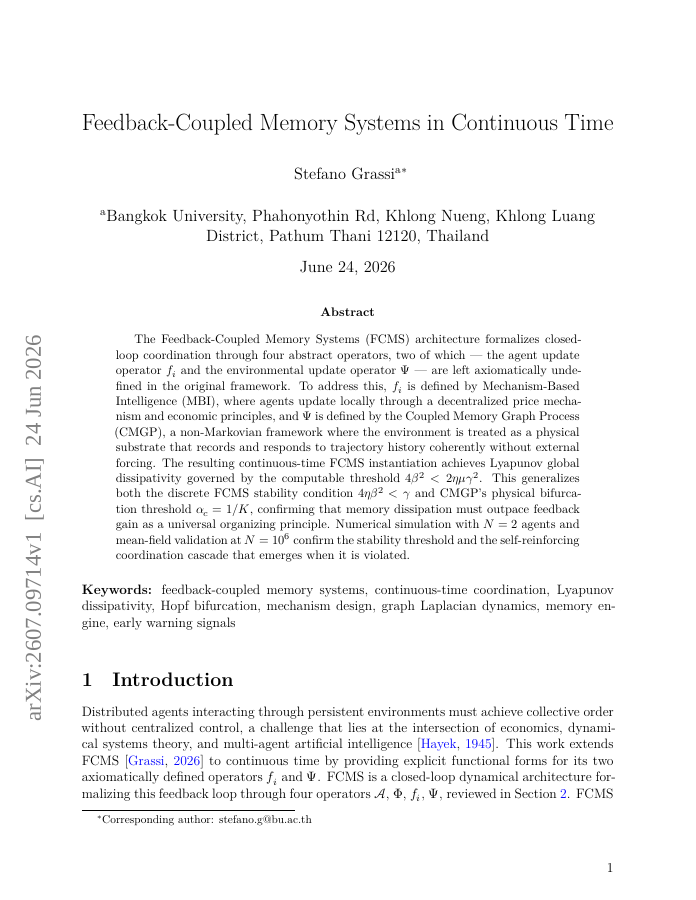
The Feedback-Coupled Memory Systems (FCMS) architecture formalizes closed-loop coordination through four abstract operators, two of which - the agent update operator f_i and the environmental update operator Ψ - are left axiomatically undefined in the original framework. To address this, f_i is defined by Mechanism-Based Intelligence (MBI), where agents update locally through a decentralized price mechanism and economic principles, and Ψ is defined by the Coupled Memory Graph Process (CMGP), a non-Markovian framework where the environment is treated as a physical substrate that records and responds to trajectory history coherently without external forcing. The resulting continuous-time FCMS instantiation achieves Lyapunov global dissipativity governed by the computable threshold 4β^2 < 2ημγ^2. This generalizes both the discrete FCMS stability condition 4ηβ^2 < γ and CMGP's physical bifurcation threshold α_c = 1/K, confirming that memory dissipation must outpace feedback gain as a universal organizing principle. Numerical simulation with N=2 agents and mean-field validation at N=10^6 confirm the stability threshold and the self-reinforcing coordination cascade that emerges when it is violated.
Feedback-Coupled Memory Systems in Continuous Time
The Feedback-Coupled Memory Systems (FCMS) architecture formalizes closed-loop coordination through four abstract operators, two of which - the agent update operator $f_i$ and the environmental update operator $Ψ$ - are left axiomatically undefined in the original framework.
- Preview
- Year
- 2026
- Hosting
- Full text hostedCC-BY-4.0
Cite
Notes
Only stored in your browser.
Attribution
- Abstract & full text
- arxiv.org/abs/2607.09714CC-BY-4.0
- TL;DR
- Semantic Scholar