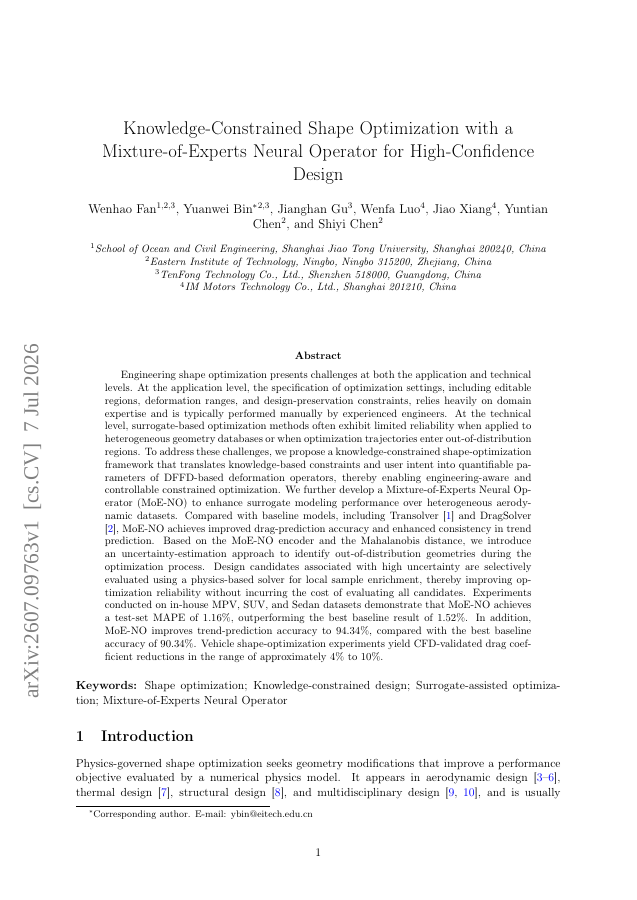
Engineering shape optimization faces challenges in both expert-dependent problem setup and surrogate-model reliability. In practical aerodynamic design, optimization settings such as editable regions, deformation ranges, and design-preservation constraints are typically specified manually by experienced engineers, while surrogate-based optimization may become unreliable for heterogeneous geometry databases and out-of-distribution designs. To address these challenges, we propose a knowledge-constrained shape-optimization framework that translates knowledge-based constraints and user intent into quantifiable parameters of DFFD-based deformation operators, enabling engineering-aware and controllable constrained optimization. We further develop a Mixture-of-Experts Neural Operator (MoE-NO) to improve drag prediction and trend consistency over heterogeneous aerodynamic datasets. Based on the MoE-NO encoder and Mahalanobis distance, an uncertainty-estimation strategy is introduced to detect out-of-distribution geometries and selectively trigger physics-solver feedback for local sample enrichment. Experiments on in-house MPV, SUV, and Sedan datasets show that MoE-NO achieves a test-set MAPE of 1.16% and a trend-prediction accuracy of 94.34%, outperforming the best baseline results of 1.52% and 90.34%, respectively. Vehicle shape-optimization experiments further yield CFD-validated drag coefficient reductions of approximately 4% to 10%.
Knowledge-Constrained Shape Optimization with a Mixture-of-Experts Neural Operator for High-Confidence Design
Engineering shape optimization faces challenges in both expert-dependent problem setup and surrogate-model reliability. In practical aerodynamic design, optimization settings such as editable regions, deformation ranges, and design-preservation constraints are typically…
- Preview
- Year
- 2026
- Hosting
- Full text hostedCC-BY-4.0
Cite
Notes
Only stored in your browser.
Attribution
- Abstract & full text
- arxiv.org/abs/2607.09763CC-BY-4.0
- TL;DR
- Semantic Scholar