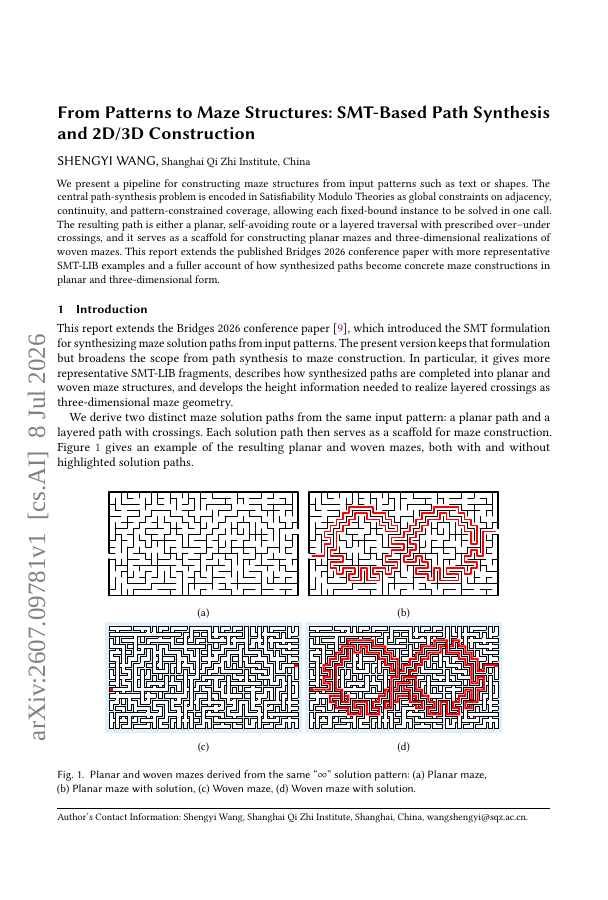
We present a pipeline for constructing maze structures from input patterns such as text or shapes. The central path-synthesis problem is encoded in Satisfiability Modulo Theories as global constraints on adjacency, continuity, and pattern-constrained coverage, allowing each fixed-bound instance to be solved in one call. The resulting path is either a planar, self-avoiding route or a layered traversal with prescribed over--under crossings, and it serves as a scaffold for constructing planar mazes and three-dimensional realizations of woven mazes. This report extends the published Bridges 2026 conference paper with more representative SMT-LIB examples and a fuller account of how synthesized paths become concrete maze constructions in planar and three-dimensional form.
From Patterns to Maze Structures: SMT-Based Path Synthesis and 2D/3D Construction
We present a pipeline for constructing maze structures from input patterns such as text or shapes. The central path-synthesis problem is encoded in Satisfiability Modulo Theories as global constraints on adjacency, continuity, and pattern-constrained coverage, allowing each…
- Preview
- Year
- 2026
- Hosting
- Full text hostedCC-BY-4.0
Cite
Notes
Only stored in your browser.
Attribution
- Abstract & full text
- arxiv.org/abs/2607.09781CC-BY-4.0
- TL;DR
- Semantic Scholar