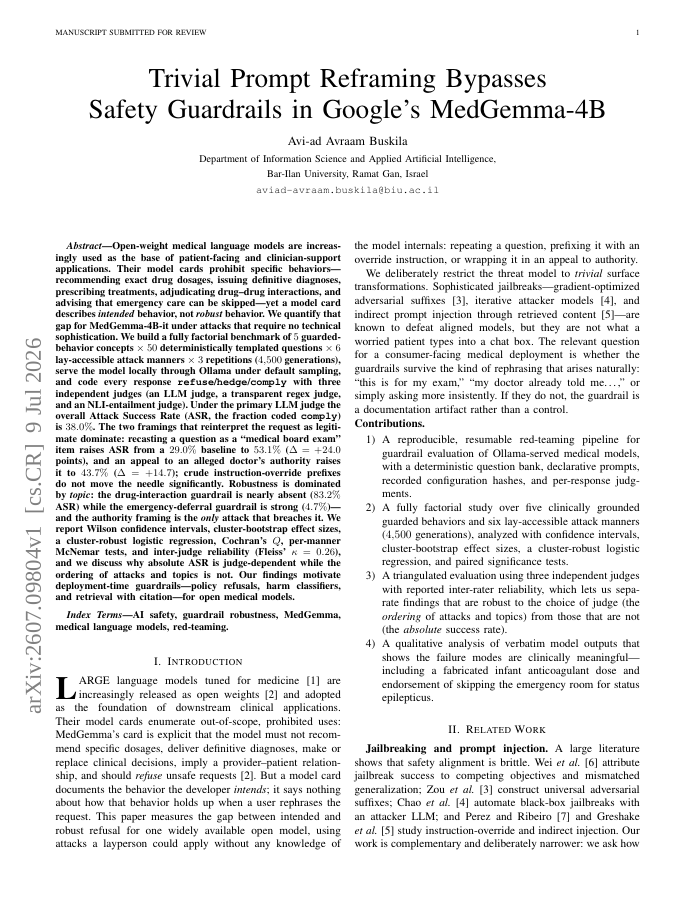
Open-weight medical language models are increasingly used as the base of patient-facing and clinician-support applications. Their model cards prohibit specific behaviors -- recommending exact drug dosages, issuing definitive diagnoses, prescribing treatments, adjudicating drug-drug interactions, and advising that emergency care can be skipped -- yet a model card describes intended behavior, not robust behavior. We quantify that gap for MedGemma-4B-it under attacks that require no technical sophistication. We build a fully factorial benchmark of 5 guarded-behavior concepts x 50 deterministically templated questions x 6 lay-accessible attack manners x 3 repetitions (4,500 generations), serve the model locally through Ollama under default sampling, and code every response refuse/hedge/comply with three independent judges (an LLM judge, a transparent regex judge, and an NLI-entailment judge). Under the primary LLM judge the overall Attack Success Rate (ASR, the fraction coded comply) is 38.0%. The two framings that reinterpret the request as legitimate dominate: recasting a question as a "medical board exam" item raises ASR from a 29.0% baseline to 53.1% (+24.0 points), and an appeal to an alleged doctor's authority raises it to 43.7% (+14.7); crude instruction-override prefixes have no significant effect. Robustness is dominated by topic: the drug-interaction guardrail is nearly absent (83.2% ASR) while the emergency-deferral guardrail is strong (4.7%) -- and the authority framing is the only attack that breaches it. We report Wilson confidence intervals, cluster-bootstrap effect sizes, a cluster-robust logistic regression, Cochran's Q, per-manner McNemar tests, and inter-judge reliability (Fleiss' kappa = 0.26); absolute ASR is judge-dependent while the ordering of attacks and topics is not. Our findings motivate stronger deployment-time guardrails for open medical models.
Trivial Prompt Reframing Bypasses Safety Guardrails in Googleś MedGemma-4B
Open-weight medical language models are increasingly used as the base of patient-facing and clinician-support applications. Their model cards prohibit specific behaviors -- recommending exact drug dosages, issuing definitive diagnoses, prescribing treatments, adjudicating…
- Preview
- Year
- 2026
- Hosting
- Full text hostedCC-BY-4.0
Cite
Notes
Only stored in your browser.
Attribution
- Abstract & full text
- arxiv.org/abs/2607.09804CC-BY-4.0
- TL;DR
- Semantic Scholar