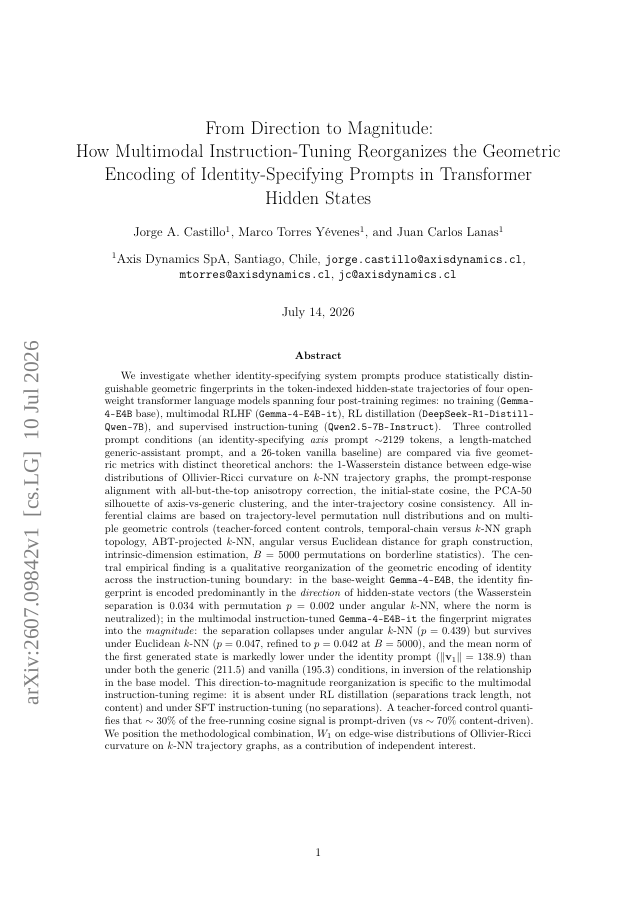
We investigate whether identity-specifying system prompts produce statistically distinguishable geometric fingerprints in the hidden-state trajectories of four open-weight transformer language models spanning four post-training regimes: no training (Gemma-4-E4B base), multimodal RLHF (Gemma-4-E4B-it), RL distillation (DeepSeek-R1-Distill-Qwen-7B), and SFT (Qwen2.5-7B-Instruct). Three prompt conditions (an identity-specifying axis prompt, a length-matched generic-assistant prompt, and a 26-token vanilla baseline) are compared via five geometric metrics, principally the 1-Wasserstein distance between edge-wise distributions of Ollivier-Ricci curvature on k-NN trajectory graphs. Claims rest on trajectory-level permutation tests with multiple geometric controls (teacher-forced content controls, temporal-chain vs k-NN topology, ABT-projected k-NN, angular vs Euclidean graph construction, B=5000 permutations on borderline statistics). The central finding is a qualitative reorganization of identity encoding across the instruction-tuning boundary: in the base model the fingerprint is direction-coded (separation 0.034, p=0.002 under angular k-NN); in the multimodal instruction-tuned model it migrates into the magnitude (angular separation collapses to p=0.439 while Euclidean survives at p=0.042, and the mean norm of the first generated state inverts its length-ordering, being lowest for the identity prompt). This direction-to-magnitude reorganization is specific to the multimodal instruction-tuning regime, absent under RL distillation and SFT. A teacher-forced control attributes 30% of the free-running cosine signal to prompt-driven effects. We position W_1 on edge-wise Ollivier-Ricci distributions on k-NN trajectory graphs as a methodological contribution of independent interest.
From Direction to Magnitude: How Multimodal Instruction-Tuning Reorganizes the Geometric Encoding of Identity-Specifying Prompts in Transformer Hidden States
We investigate whether identity-specifying system prompts produce statistically distinguishable geometric fingerprints in the hidden-state trajectories of four open-weight transformer language models spanning four post-training regimes: no training (Gemma-4-E4B base), multimodal…
- Preview
- Year
- 2026
- Hosting
- Excerpt onlyCC-BY-NC-4.0
Cite
Notes
Only stored in your browser.
Attribution
- Abstract & full text
- arxiv.org/abs/2607.09842CC-BY-NC-4.0
- TL;DR
- Semantic Scholar