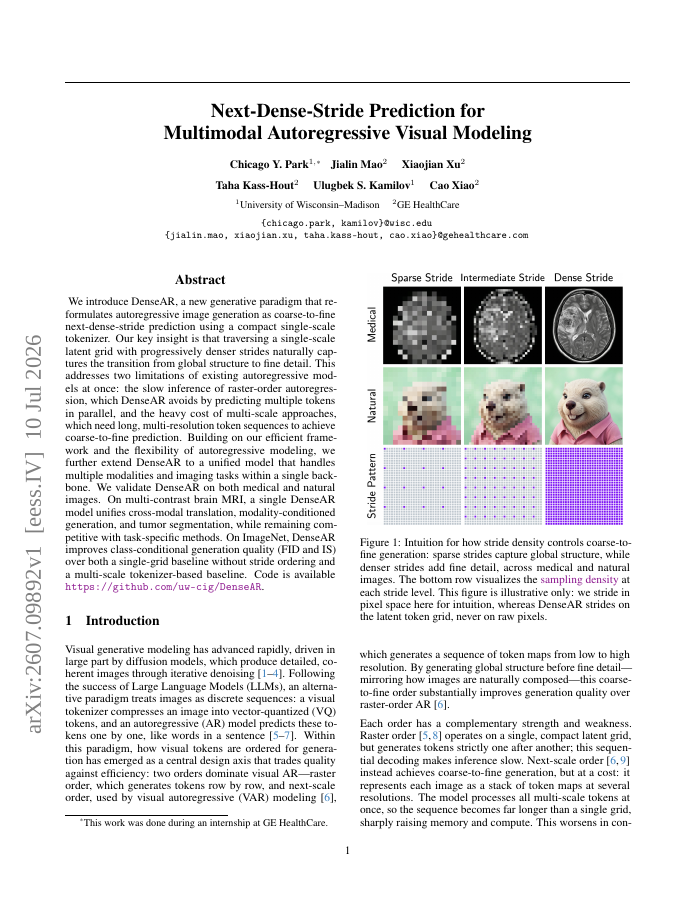
We introduce DenseAR, a new generative paradigm that reformulates autoregressive image generation as coarse-to-fine next-dense-stride prediction using a compact single-scale tokenizer. Our key insight is that traversing a single-scale latent grid with progressively denser strides naturally captures the transition from global structure to fine detail. This addresses two limitations of existing autoregressive models at once: the slow inference of raster-order autoregression, which DenseAR avoids by predicting multiple tokens in parallel, and the heavy cost of multi-scale approaches, which need long, multi-resolution token sequences to achieve coarse-to-fine prediction. Building on our efficient framework and the flexibility of autoregressive modeling, we further extend DenseAR to a unified model that handles multiple modalities and imaging tasks within a single backbone. We validate DenseAR on both medical and natural images. On multi-contrast brain MRI, a single DenseAR model unifies cross-modal translation, modality-conditioned generation, and tumor segmentation, while remaining competitive with task-specific methods. On ImageNet, DenseAR improves class-conditional generation quality (FID and IS) over both a single-grid baseline without stride ordering and a multi-scale tokenizer-based baseline.
Next-Dense-Stride Prediction for Multimodal Autoregressive Visual Modeling
We introduce DenseAR, a new generative paradigm that reformulates autoregressive image generation as coarse-to-fine next-dense-stride prediction using a compact single-scale tokenizer.
- Preview
- Year
- 2026
- Hosting
- Full text hostedCC-BY-4.0
Cite
Notes
Only stored in your browser.
Attribution
- Abstract & full text
- arxiv.org/abs/2607.09892CC-BY-4.0
- TL;DR
- Semantic Scholar