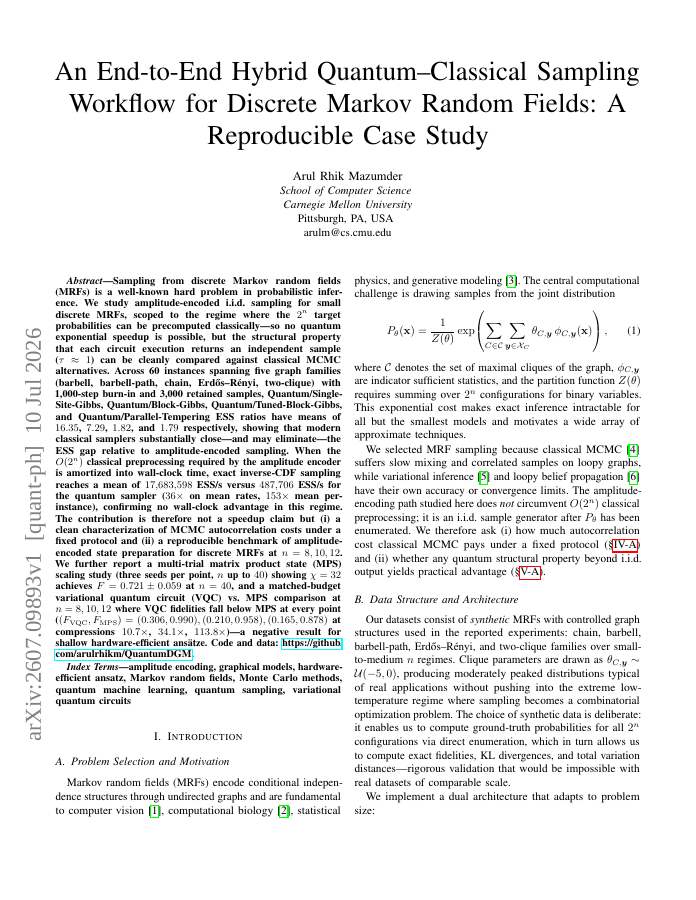
Sampling from discrete Markov random fields (MRFs) is a hard problem. We study amplitude-encoded i.i.d. sampling for small MRFs where 2^n target probabilities are precomputed classically. This removes quantum exponential speedup but allows a clean comparison against classical MCMC based on independent circuit samples (τ\approx 1). Across 60 instances spanning five graph families (1k-step burn-in, 3k retained samples), the mean ESS ratios of Quantum to Single-Site Gibbs, Block Gibbs, Tuned-Block, and Parallel Tempering are 16.35, 7.29, 1.82, and 1.79, showing modern classical samplers substantially close this gap. Amortizing O(2^n) preprocessing into wall-clock time, exact inverse-CDF sampling yields 17.7M ESS/s versus 488K ESS/s for the quantum sampler (36\times mean rate, 153\times per-instance), confirming no wall-clock advantage. We characterize MCMC autocorrelation costs and benchmark amplitude-encoded state preparation at n \in {8,10,12}. An MPS scaling study (n \le 40) shows bond dimension χ=32 achieves F=0.721\pm0.059 at n=40. Finally, a matched-budget VQC vs. MPS comparison at n \in {8,10,12} shows VQC fidelities fall far below MPS: (F_{VQC}, F_{MPS}) = (0.31, 0.99), (0.21, 0.96), (0.17, 0.88) at compressions 10.7\times, 34.1\times, and 113.8\times.
An End-to-End Hybrid Quantum--Classical Sampling Workflow for Discrete Markov Random Fields: A Reproducible Case Study
Sampling from discrete Markov random fields (MRFs) is a hard problem. We study amplitude-encoded i.i.d. sampling for small MRFs where $2^n$ target probabilities are precomputed classically.
- Preview
- Year
- 2026
- Hosting
- Full text hostedCC-BY-4.0
Cite
Notes
Only stored in your browser.
Attribution
- Abstract & full text
- arxiv.org/abs/2607.09893CC-BY-4.0
- TL;DR
- Semantic Scholar