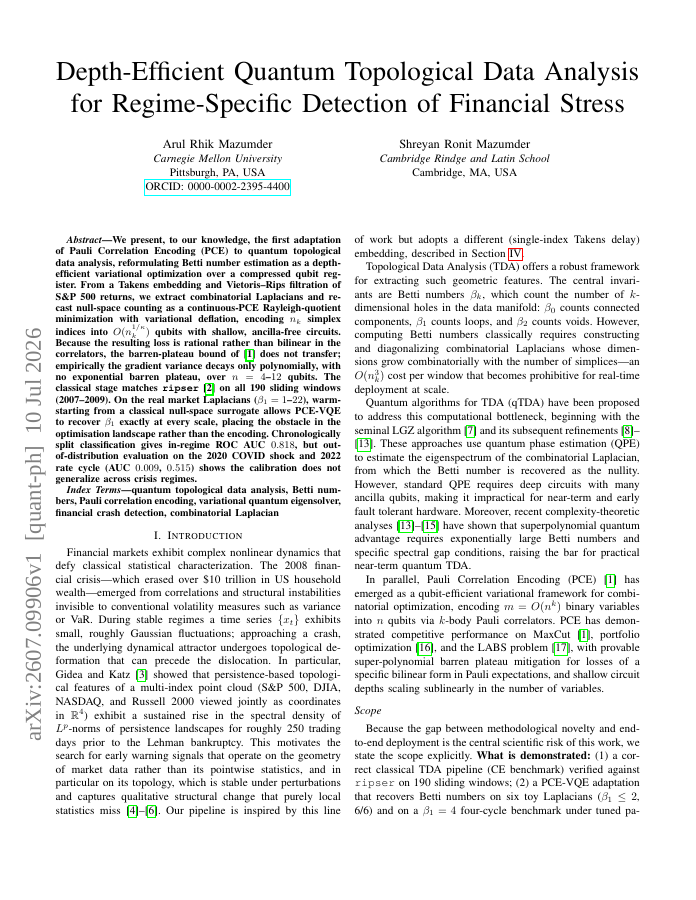
We present, to our knowledge, the first adaptation of Pauli Correlation Encoding (PCE) to quantum topological data analysis, reformulating Betti number estimation as a depth-efficient variational optimization over a compressed qubit register. From a Takens embedding and Vietoris--Rips filtration of S&P 500 returns, we extract combinatorial Laplacians and recast null-space counting as a continuous-PCE Rayleigh-quotient minimization with variational deflation, encoding n_k simplex indices into O(n_k^{1/κ}) qubits with shallow, ancilla-free circuits. Because the resulting loss is rational rather than bilinear in the correlators, the barren-plateau bound of \cite{Sciorilli25} does not transfer; empirically the gradient variance decays only polynomially, with no exponential barren plateau, over n=4--12 qubits. The classical stage matches ripser \cite{bauer2021ripser} on all 190 sliding windows (2007-2009). On the real market Laplacians (β_1=1--22), warm-starting from a classical null-space surrogate allows PCE-VQE to recover β_1 exactly at every scale, placing the obstacle in the optimisation landscape rather than the encoding. Chronologically split classification gives in-regime ROC AUC 0.818, but out-of-distribution evaluation on the 2020 COVID shock and 2022 rate cycle (AUC 0.009, 0.515) shows the calibration does not generalize across crisis regimes.
Depth-Efficient Quantum Topological Data Analysis for Regime-Specific Detection of Financial Stress
We present, to our knowledge, the first adaptation of Pauli Correlation Encoding (PCE) to quantum topological data analysis, reformulating Betti number estimation as a depth-efficient variational optimization over a compressed qubit register.
- Preview
- Year
- 2026
- Hosting
- Full text hostedCC-BY-4.0
Cite
Notes
Only stored in your browser.
Attribution
- Abstract & full text
- arxiv.org/abs/2607.09906CC-BY-4.0
- TL;DR
- Semantic Scholar