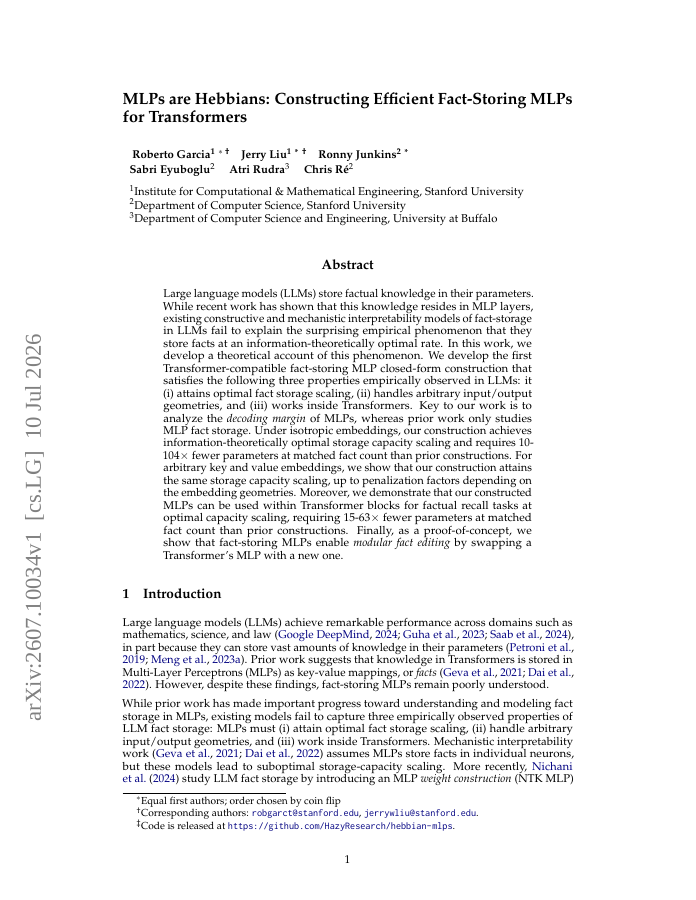
Large language models (LLMs) store factual knowledge in their parameters. While recent work has shown that this knowledge resides in MLP layers, existing constructive and mechanistic interpretability models of fact-storage in LLMs fail to explain the surprising empirical phenomenon that they store facts at an information-theoretically optimal rate. In this work, we develop a theoretical account of this phenomenon. We develop the first Transformer-compatible fact-storing MLP closed-form construction that satisfies the following three properties empirically observed in LLMs: it (i) attains optimal fact storage scaling, (ii) handles arbitrary input/output geometries, and (iii) works inside Transformers. Key to our work is to analyze the decoding margin of MLPs, whereas prior work only studies MLP fact storage. Under isotropic embeddings, our construction achieves information-theoretically optimal storage capacity scaling and requires 10-104\times fewer parameters at matched fact count than prior constructions. For arbitrary key and value embeddings, we show that our construction attains the same storage capacity scaling, up to penalization factors depending on the embedding geometries. Moreover, we demonstrate that our constructed MLPs can be used within Transformer blocks for factual recall tasks at optimal capacity scaling, requiring 15-63\times fewer parameters at matched fact count than prior constructions. Finally, as a proof-of-concept, we show that fact-storing MLPs enable modular fact editing by swapping a Transformer's MLP with a new one.
MLPs are Hebbians: Constructing Efficient Fact-Storing MLPs for Transformers
Large language models (LLMs) store factual knowledge in their parameters. While recent work has shown that this knowledge resides in MLP layers, existing constructive and mechanistic interpretability models of fact-storage in LLMs fail to explain the surprising empirical…
- Preview
- Year
- 2026
- Hosting
- Full text hostedCC-BY-SA-4.0
Cite
Notes
Only stored in your browser.
Attribution
- Abstract & full text
- arxiv.org/abs/2607.10034CC-BY-SA-4.0
- TL;DR
- Semantic Scholar