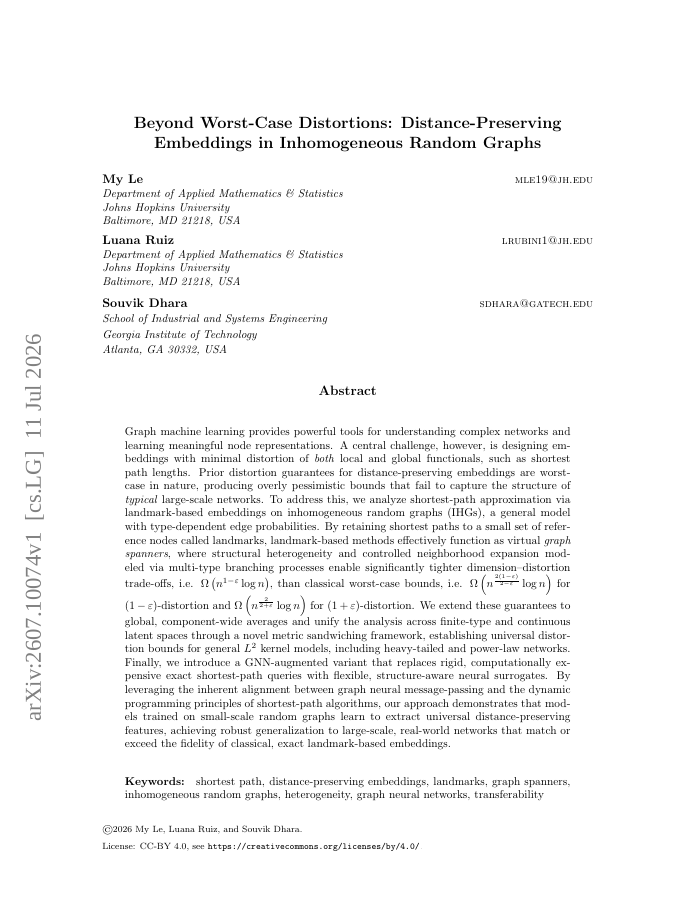
Graph machine learning provides powerful tools for understanding complex networks and learning meaningful node representations. A central challenge, however, is designing embeddings with minimal distortion of both local and global functionals, such as shortest path lengths. Prior distortion guarantees for distance-preserving embeddings are worst-case in nature, producing overly pessimistic bounds that fail to capture the structure of typical large-scale networks. To address this, we analyze shortest-path approximation via landmark-based embeddings on inhomogeneous random graphs, a general model with type-dependent edge probabilities. By retaining shortest paths to a small set of reference nodes called landmarks, landmark-based methods effectively function as virtual graph spanners, where structural heterogeneity and controlled neighborhood expansion modeled via multi-type branching processes enable significantly tighter dimension-distortion trade-offs than classical worst-case bounds. We extend these guarantees to global, component-wide averages and unify the analysis across finite-type and continuous latent spaces through a novel metric sandwiching framework, establishing universal distortion bounds for general L^2 kernel models, including heavy-tailed and power-law networks. Finally, we introduce a GNN-augmented variant that replaces rigid, computationally expensive exact shortest-path queries with flexible, structure-aware neural surrogates. By leveraging the inherent alignment between graph neural message-passing and the dynamic programming principles of shortest-path algorithms, our approach demonstrates that models trained on small-scale random graphs learn to extract universal distance-preserving features, achieving robust generalization to large-scale, real-world networks that match or exceed the fidelity of classical, exact landmark-based embeddings.
Distance-Preserving Embeddings in Inhomogeneous Random Graphs
Graph machine learning provides powerful tools for understanding complex networks and learning meaningful node representations. A central challenge, however, is designing embeddings with minimal distortion of both local and global functionals, such as shortest path lengths.
- Preview
- Year
- 2026
- Hosting
- Abstract onlyARXIV-DEFAULT
Cite
Notes
Only stored in your browser.
Attribution
- Abstract & full text
- arxiv.org/abs/2607.10074ARXIV-DEFAULT
- TL;DR
- Semantic Scholar