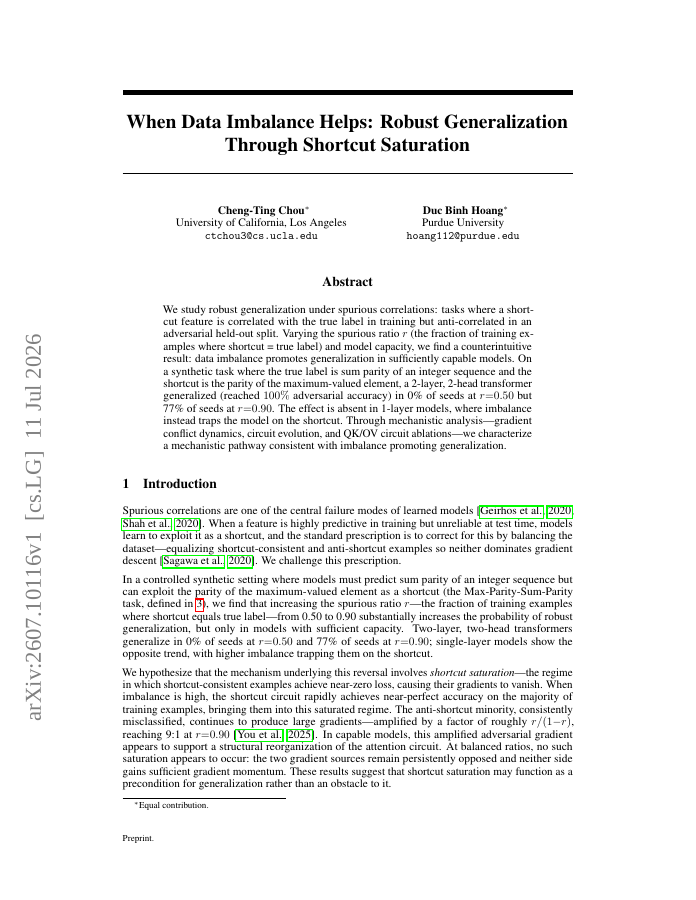
We study robust generalization under spurious correlations: tasks where a shortcut feature is correlated with the true label in training but anti-correlated in an adversarial held-out split. Varying the spurious ratio r (the fraction of training examples where shortcut = true label) and model capacity, we find a counterintuitive result: data imbalance promotes generalization in sufficiently capable models. On a synthetic task where the true label is sum parity of an integer sequence and the shortcut is the parity of the maximum-valued element, a 2-layer, 2-head transformer generalized (reached 100% adversarial accuracy) in 0% of seeds at r{=}0.50 but 77% of seeds at r{=}0.90. The effect is absent in 1-layer models, where imbalance instead traps the model on the shortcut. Through mechanistic analysis -- gradient conflict dynamics, circuit evolution, and QK/OV circuit ablations -- we characterize a mechanistic pathway consistent with imbalance promoting generalization.
When Data Imbalance Helps: Robust Generalization Through Shortcut Saturation
We study robust generalization under spurious correlations: tasks where a shortcut feature is correlated with the true label in training but anti-correlated in an adversarial held-out split.
- Preview
- Year
- 2026
- Hosting
- Full text hostedCC-BY-4.0
Cite
Notes
Only stored in your browser.
Attribution
- Abstract & full text
- arxiv.org/abs/2607.10116CC-BY-4.0
- TL;DR
- Semantic Scholar