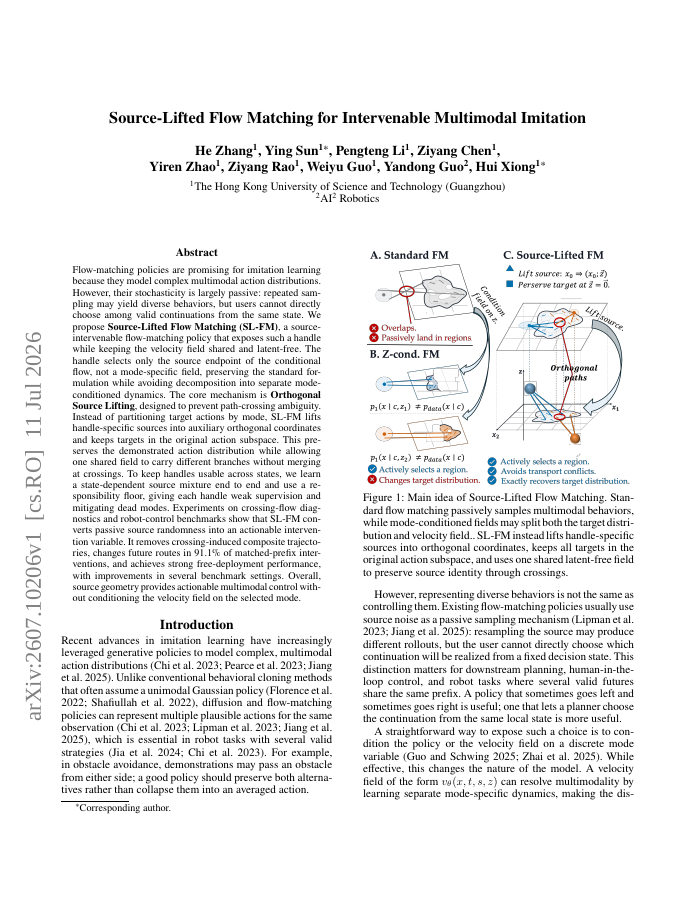
Flow-matching policies are promising for imitation learning because they model complex multimodal action distributions. However, their stochasticity is largely passive: repeated sampling may yield diverse behaviors, but users cannot directly choose among valid continuations from the same state. We propose Source-Lifted Flow Matching (SL-FM), a source-intervenable flow-matching policy that exposes such a handle while keeping the velocity field shared and latent-free. The handle selects only the source endpoint of the conditional flow, not a mode-specific field, preserving the standard formulation while avoiding decomposition into separate mode-conditioned dynamics. The core mechanism is Orthogonal Source Lifting, designed to prevent path-crossing ambiguity. Instead of partitioning target actions by mode, SL-FM lifts handle-specific sources into auxiliary orthogonal coordinates and keeps targets in the original action subspace. This preserves the demonstrated action distribution while allowing one shared field to carry different branches without merging at crossings. To keep handles usable across states, we learn a state-dependent source mixture end to end and use a responsibility floor, giving each handle weak supervision and mitigating dead modes. Experiments on crossing-flow diagnostics and robot-control benchmarks show that SL-FM converts passive source randomness into an actionable intervention variable. It removes crossing-induced composite trajectories, changes future routes in 91.1% of matched-prefix interventions, and achieves strong free-deployment performance, with improvements in several benchmark settings. Overall, source geometry provides actionable multimodal control without conditioning the velocity field on the selected mode.
Source-Lifted Flow Matching for Intervenable Multimodal Imitation
Flow-matching policies are promising for imitation learning because they model complex multimodal action distributions. However, their stochasticity is largely passive: repeated sampling may yield diverse behaviors, but users cannot directly choose among valid continuations from…
- Preview
- Year
- 2026
- Hosting
- Abstract onlyARXIV-DEFAULT
Cite
Notes
Only stored in your browser.
Attribution
- Abstract & full text
- arxiv.org/abs/2607.10206ARXIV-DEFAULT
- TL;DR
- Semantic Scholar