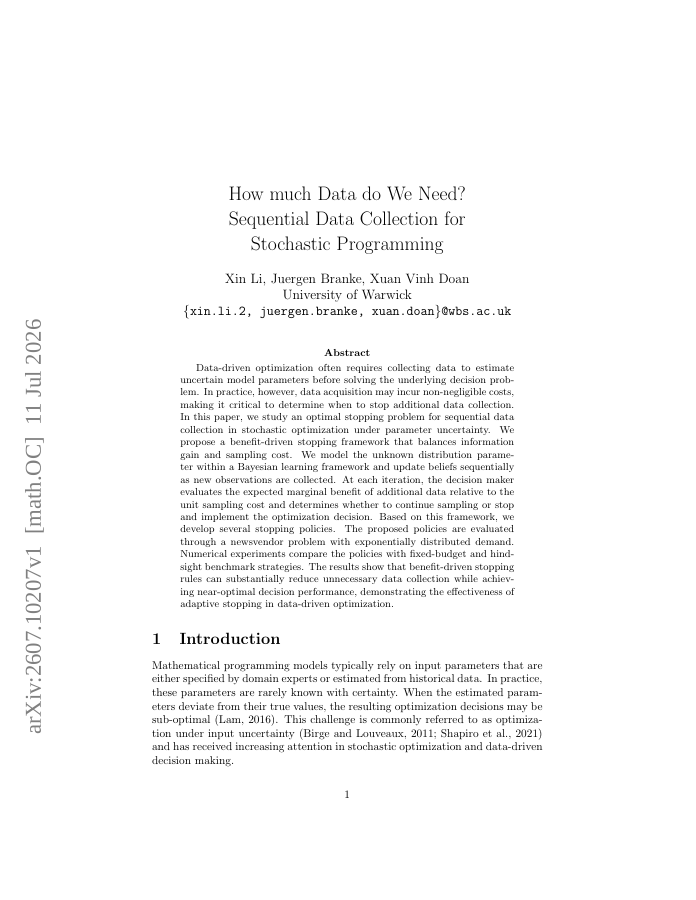
Data-driven optimization often requires collecting data to estimate uncertain model parameters before solving the underlying decision problem. In practice, however, data acquisition may incur non-negligible costs, making it critical to determine when to stop additional data collection. In this paper, we study an optimal stopping problem for sequential data collection in stochastic optimization under parameter uncertainty. We propose a benefit-driven stopping framework that balances information gain and sampling cost. We model the unknown distribution parameter within a Bayesian learning framework and update beliefs sequentially as new observations are collected. At each iteration, the decision maker evaluates the expected marginal benefit of additional data relative to the unit sampling cost and determines whether to continue sampling or stop and implement the optimization decision. Based on this framework, we develop several stopping policies. The proposed policies are evaluated through a newsvendor problem with exponentially distributed demand. Numerical experiments compare the policies with fixed-budget and hindsight benchmark strategies. The results show that benefit-driven stopping rules can substantially reduce unnecessary data collection while achieving near-optimal decision performance, demonstrating the effectiveness of adaptive stopping in data-driven optimization.
How much Data do We Need? Sequential Data Collection for Stochastic Programming
Data-driven optimization often requires collecting data to estimate uncertain model parameters before solving the underlying decision problem. In practice, however, data acquisition may incur non-negligible costs, making it critical to determine when to stop additional data…
- Preview
- Year
- 2026
- Hosting
- Excerpt onlyCC-BY-NC-4.0
Cite
Notes
Only stored in your browser.
Attribution
- Abstract & full text
- arxiv.org/abs/2607.10207CC-BY-NC-4.0
- TL;DR
- Semantic Scholar