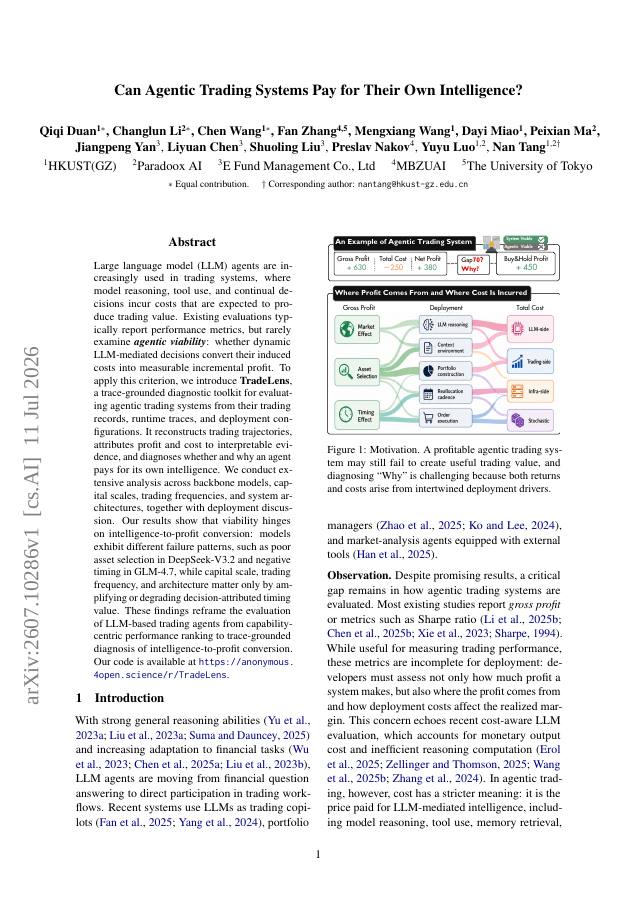
Large language model (LLM) agents are increasingly used in trading systems, where model reasoning, tool use, and continual decisions incur costs that are expected to produce trading value. Existing evaluations typically report performance metrics, but rarely examine agentic viability: whether dynamic LLM-mediated decisions convert their induced costs into measurable incremental profit. To apply this criterion, we introduce TradeLens, a trace-grounded diagnostic toolkit for evaluating agentic trading systems from their trading records, runtime traces, and deployment configurations. It reconstructs trading trajectories, attributes profit and cost to interpretable evidence, and diagnoses whether and why an agent pays for its own intelligence. We conduct extensive analysis across backbone models, capital scales, trading frequencies, and system architectures, together with deployment discussion. Our results show that viability hinges on intelligence-to-profit conversion: models exhibit different failure patterns, such as poor asset selection in DeepSeek-V3.2 and negative timing in GLM-4.7, while capital scale, trading frequency, and architecture matter only by amplifying or degrading decision-attributed timing value. These findings reframe the evaluation of LLM-based trading agents from capability-centric performance ranking to trace-grounded diagnosis of intelligence-to-profit conversion. Our code is available at https://anonymous.4open.science/r/TradeLens.
Can Agentic Trading Systems Pay for Their Own Intelligence?
Large language model (LLM) agents are increasingly used in trading systems, where model reasoning, tool use, and continual decisions incur costs that are expected to produce trading value.
- Preview
- Year
- 2026
- Hosting
- Excerpt onlyCC-BY-NC-SA-4.0
Cite
Notes
Only stored in your browser.
Attribution
- Abstract & full text
- arxiv.org/abs/2607.10286CC-BY-NC-SA-4.0
- TL;DR
- Semantic Scholar