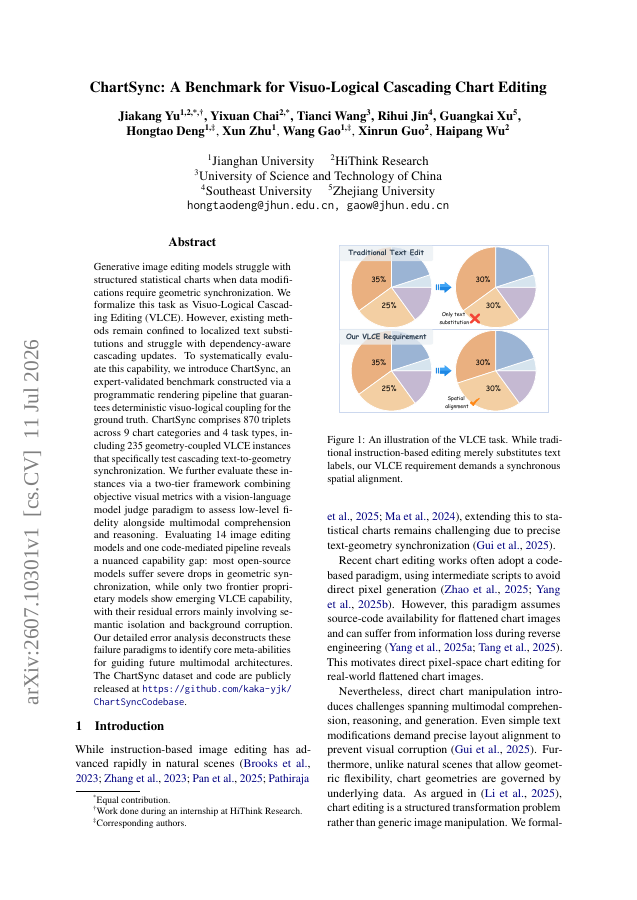
Generative image editing models struggle with structured statistical charts when data modifications require geometric synchronization. We formalize this task as Visuo-Logical Cascading Editing (VLCE). However, existing methods remain confined to localized text substitutions and struggle with dependency-aware cascading updates. To systematically evaluate this capability, we introduce ChartSync, an expert-validated benchmark constructed via a programmatic rendering pipeline that guarantees deterministic visuo-logical coupling for the ground truth. ChartSync comprises 870 triplets across 9 chart categories and 4 task types, including 235 geometry-coupled VLCE instances that specifically test cascading text-to-geometry synchronization. We further evaluate these instances via a two-tier framework combining objective visual metrics with a vision-language model judge paradigm to assess low-level fidelity alongside multimodal comprehension and reasoning. Evaluating 14 image editing models and one code-mediated pipeline reveals a nuanced capability gap: most open-source models suffer severe drops in geometric synchronization, while only two frontier proprietary models show emerging VLCE capability, with their residual errors mainly involving semantic isolation and background corruption. Our detailed error analysis deconstructs these failure paradigms to identify core meta-abilities for guiding future multimodal architectures. The ChartSync dataset and code are publicly released at https://github.com/kaka-yjk/ChartSyncCodebase.
ChartSync: A Benchmark for Visuo-Logical Cascading Chart Editing
Generative image editing models struggle with structured statistical charts when data modifications require geometric synchronization. We formalize this task as Visuo-Logical Cascading Editing (VLCE).
- Preview
- Year
- 2026
- Hosting
- Full text hostedCC-BY-4.0
Cite
Notes
Only stored in your browser.
Attribution
- Abstract & full text
- arxiv.org/abs/2607.10301CC-BY-4.0
- TL;DR
- Semantic Scholar