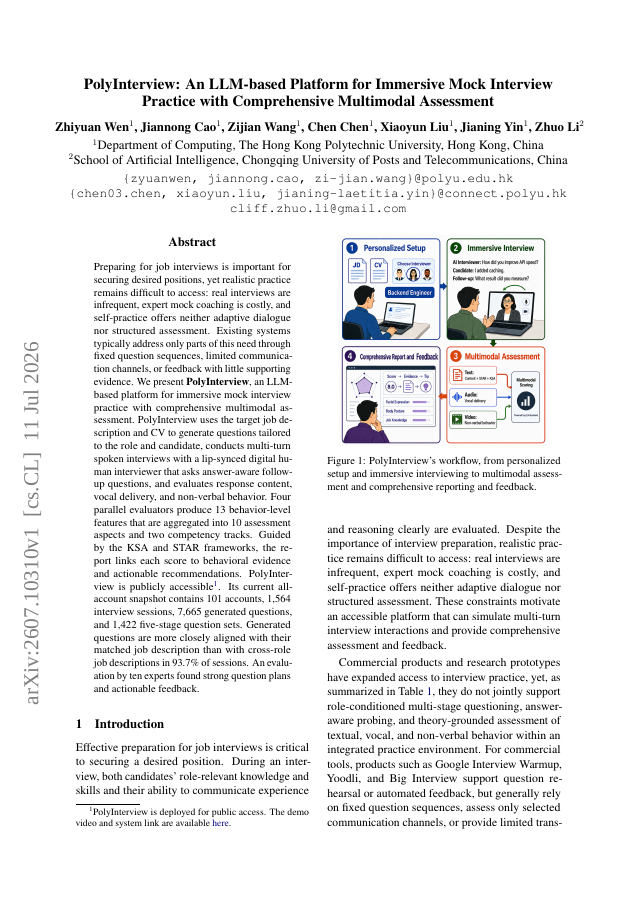
Preparing for job interviews is important for securing desired positions, yet realistic practice remains difficult to access: real interviews are infrequent, expert mock coaching is costly, and self-practice offers neither adaptive dialogue nor structured assessment. Existing systems typically address only parts of this need through fixed question sequences, limited communication channels, or feedback with little supporting evidence. We present PolyInterview, an LLM-based platform for immersive mock interview practice with comprehensive multimodal assessment. PolyInterview uses the target job description and CV to generate questions tailored to the role and candidate, conducts multi-turn spoken interviews with a lip-synced digital human interviewer that asks answer-aware follow-up questions, and evaluates response content, vocal delivery, and non-verbal behavior. Four parallel evaluators produce 13 behavior-level features that are aggregated into 10 assessment aspects and two competency tracks. Guided by the KSA and STAR frameworks, the report links each score to behavioral evidence and actionable recommendations. PolyInterview is publicly accessible. Its current all-account snapshot contains 101 accounts, 1,564 interview sessions, 7,665 generated questions, and 1,422 five-stage question sets. Generated questions are more closely aligned with their matched job description than with cross-role job descriptions in 93.7% of sessions. An evaluation by ten experts found strong question plans and actionable feedback.
PolyInterview: An LLM-based Platform for Immersive Mock Interview Practice with Comprehensive Multimodal Assessment
Preparing for job interviews is important for securing desired positions, yet realistic practice remains difficult to access: real interviews are infrequent, expert mock coaching is costly, and self-practice offers neither adaptive dialogue nor structured assessment.
- Preview
- Year
- 2026
- Hosting
- Abstract onlyARXIV-DEFAULT
Cite
Notes
Only stored in your browser.
Attribution
- Abstract & full text
- arxiv.org/abs/2607.10310ARXIV-DEFAULT
- TL;DR
- Semantic Scholar