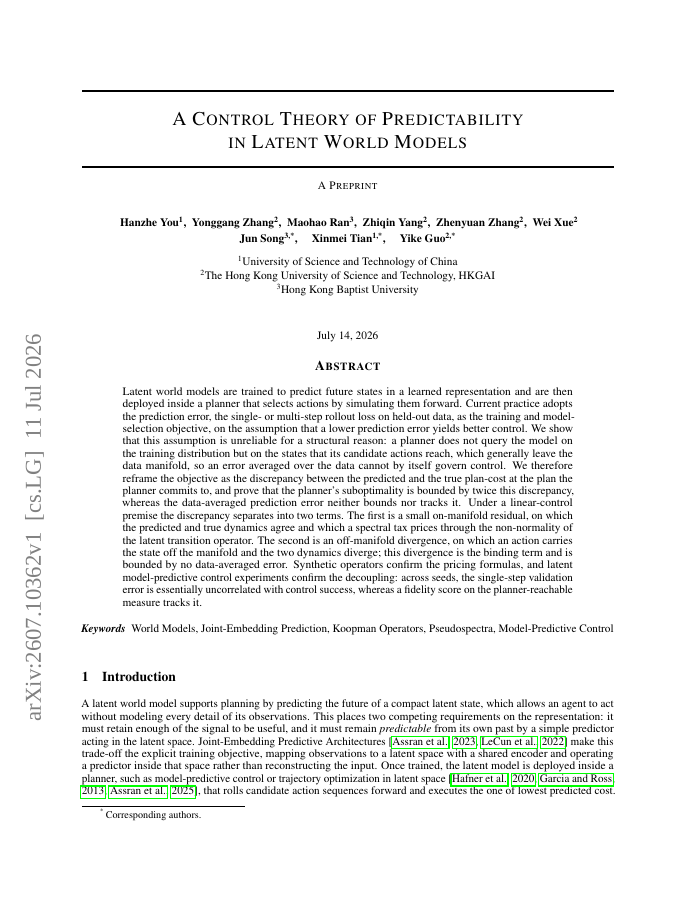
Latent world models are trained to predict future states in a learned representation and are then deployed inside a planner that selects actions by simulating them forward. Current practice adopts the prediction error, the single- or multi-step rollout loss on held-out data, as the training and model-selection objective, on the assumption that a lower prediction error yields better control. We show that this assumption is unreliable for a structural reason: a planner does not query the model on the training distribution but on the states that its candidate actions reach, which generally leave the data manifold, so an error averaged over the data cannot by itself govern control. We therefore reframe the objective as the discrepancy between the predicted and the true plan-cost at the plan the planner commits to, and prove that the planner's suboptimality is bounded by twice this discrepancy, whereas the data-averaged prediction error neither bounds nor tracks it. Under a linear-control premise the discrepancy separates into two terms. The first is a small on-manifold residual, on which the predicted and true dynamics agree and which a spectral tax prices through the non-normality of the latent transition operator. The second is an off-manifold divergence, on which an action carries the state off the manifold and the two dynamics diverge; this divergence is the binding term and is bounded by no data-averaged error. Synthetic operators confirm the pricing formulas, and latent model-predictive control experiments confirm the decoupling: across seeds, the single-step validation error is essentially uncorrelated with control success, whereas a fidelity score on the planner-reachable measure tracks it.
A Control Theory of Predictability in Latent World Models
Latent world models are trained to predict future states in a learned representation and are then deployed inside a planner that selects actions by simulating them forward.
- Preview
- Year
- 2026
- Hosting
- Abstract onlyARXIV-DEFAULT
Cite
Notes
Only stored in your browser.
Attribution
- Abstract & full text
- arxiv.org/abs/2607.10362ARXIV-DEFAULT
- TL;DR
- Semantic Scholar