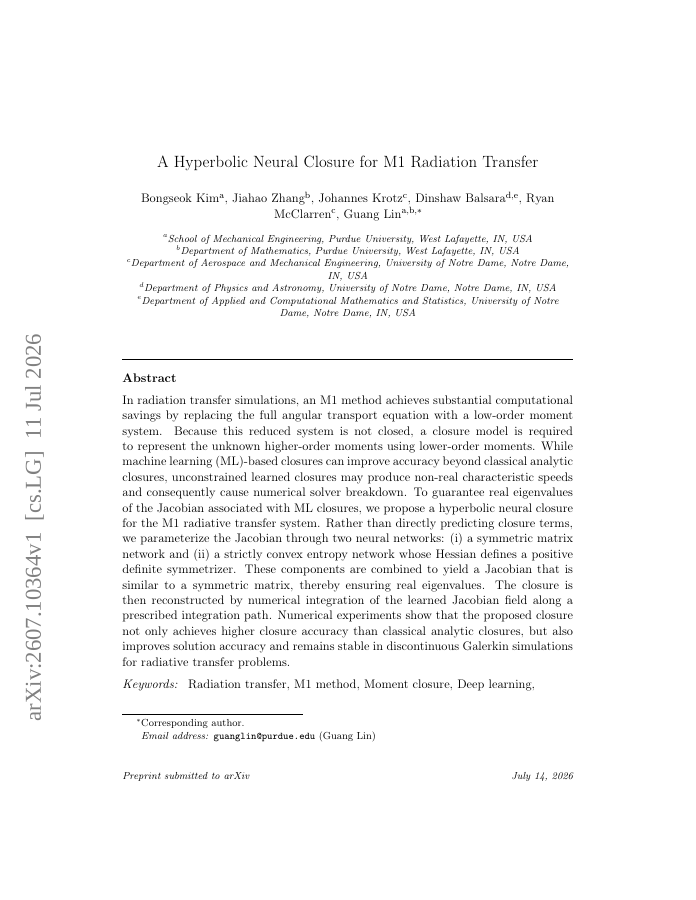
In radiation transfer simulations, an M1 method achieves substantial computational savings by replacing the full angular transport equation with a low-order moment system. Because this reduced system is not closed, a closure model is required to represent the unknown higher-order moments using lower-order moments. While machine learning (ML)-based closures can improve accuracy beyond classical analytic closures, unconstrained learned closures may produce non-real characteristic speeds and consequently cause numerical solver breakdown. To guarantee real eigenvalues of the Jacobian associated with ML closures, we propose a hyperbolic neural closure for the M1 radiative transfer system. Rather than directly predicting closure terms, we parameterize the Jacobian through two neural networks: (i) a symmetric matrix network and (ii) a strictly convex entropy network whose Hessian defines a positive definite symmetrizer. These components are combined to yield a Jacobian that is similar to a symmetric matrix, thereby ensuring real eigenvalues. The closure is then reconstructed by numerical integration of the learned Jacobian field along a prescribed integration path. Numerical experiments show that the proposed closure not only achieves higher closure accuracy than classical analytic closures, but also improves solution accuracy and remains stable in discontinuous Galerkin simulations for radiative transfer problems.
A Hyperbolic Neural Closure for M1 Radiation Transfer
In radiation transfer simulations, an M1 method achieves substantial computational savings by replacing the full angular transport equation with a low-order moment system.
- Preview
- Year
- 2026
- Hosting
- Full text hostedCC-BY-4.0
Cite
Notes
Only stored in your browser.
Attribution
- Abstract & full text
- arxiv.org/abs/2607.10364CC-BY-4.0
- TL;DR
- Semantic Scholar